
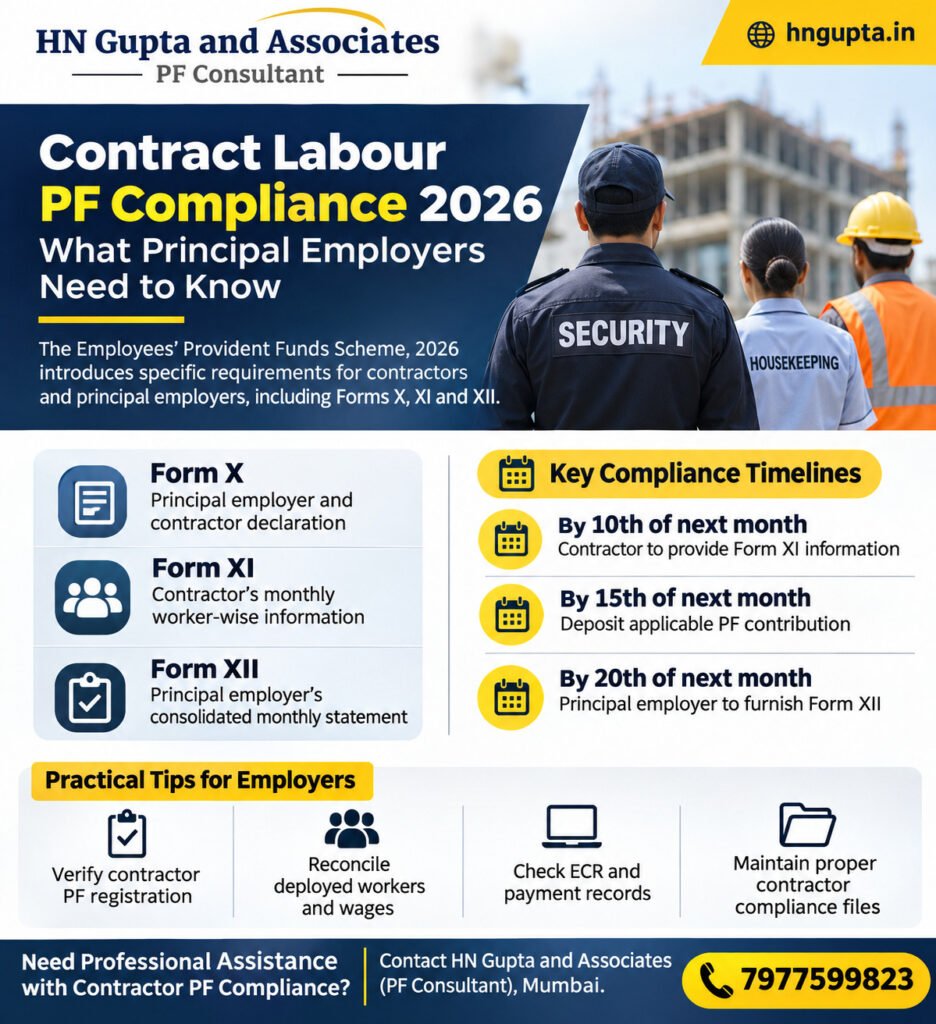
Contract Labour PF Compliance 2026: What Principal Employers Need To Know
Contract Labour PF Compliance 2026: Principal Employer Responsibilities, New Forms and Monthly Deadlines
Does your company hire security guards, housekeeping employees, construction workers or outsourced manpower through contractors? If so, verifying their Provident Fund contributions should be an important part of your monthly statutory compliance process.
Many businesses assume that appointing a registered manpower contractor transfers the entire responsibility for PF contributions to that contractor. However, principal employers can also remain responsible for statutory contributions relating to eligible contract workers.
The Employees’ Provident Funds Scheme, 2026, notified by the Ministry of Labour and Employment on 29 June 2026 and published on 1 July 2026, provides specific requirements concerning contractor declarations, employee-wise contribution information and monthly reporting.
Understanding these requirements can help employers identify compliance gaps and reduce avoidable statutory complications.
1. What is contract labour PF compliance?
Contract labour PF compliance involves ensuring that eligible employees engaged through contractors receive their applicable Provident Fund benefits.
Businesses commonly engage contractual manpower for security, housekeeping, facility management, manufacturing, logistics, construction and administrative support.
Although these employees may receive salaries directly from a contractor, the establishment engaging their services must also consider its responsibilities under the applicable social security provisions.
Employers should establish whether the workers are covered, how their contributions are being calculated and whether the applicable payments have actually been deposited.
2. What has changed under the EPF Scheme 2026?
The Employees’ Provident Funds Scheme, 2026, supersedes the earlier EPF Scheme, 1952, subject to savings for previous matters.
Paragraphs 20 and 27 of the new Scheme address contribution responsibilities and the obligations of principal employers and contractors.
Paragraph 27 establishes shared responsibility for applicable PF contributions and charges. It also specifies contractor registration and reporting requirements through Forms X, XI and XII.
Employers should therefore review existing contractor management procedures rather than relying exclusively on historical compliance practices.
Read the official Employees’ Provident Funds Scheme, 2026 for the notified provisions.
3. Understanding EPFO Forms X, XI and XII
The following forms are particularly relevant to businesses engaging contractual manpower.
Form Responsibility Purpose
Form X Principal employer Establishment registration and contractor declarations
Form XI Contractor Monthly worker-wise wage and contribution information
Form XII Principal employer Consolidated monthly contribution information
Form X — Principal employer and contractor declaration
Principal employers must ensure establishment registration and declare their contractors through the designated facility.
Businesses should maintain accurate information about their contractor agreements, work orders, contract periods and establishment identification details.
Whenever a contractor is replaced or a new manpower agency is engaged, the relevant records should be reviewed and updated.
Form XI — Monthly contractor statement
Under paragraph 27, the contractor must electronically provide the prescribed employee-wise information to the principal employer within ten days following the month’s end.
This enables the principal employer to compare deployed workers, wages and PF contribution details before completing the monthly compliance process.
Form XII — Monthly principal employer statement
The principal employer must furnish the prescribed consolidated statement within twenty days following the month’s end.
The Scheme also recognises compliance through a dedicated EPFO portal where the required information is made available through that facility.
Employers should confirm the applicable electronic filing procedure before submitting separate forms.
4. Monthly PF compliance deadlines for contract workers
Businesses should coordinate their HR, finance and contractor teams around the statutory reporting and payment requirements.
Compliance activity Standard deadline
Contractor’s Form XI information 10th of the following month
Applicable monthly PF contribution payment 15th of the following month
Principal employer’s Form XII statement 20th of the following month
These are the standard timelines specified under the Scheme. Any applicable official extensions or special directions must also be considered.
The later Form XII reporting deadline should not be treated as an extension of the PF contribution payment deadline.
5. How to verify your contractor’s PF compliance
Principal employers should implement a systematic monthly verification process instead of relying solely on a contractor’s declaration.
Step 1: Verify contractor registration
Obtain the contractor’s establishment details, PF registration information and relevant contractual documents. Determine whether the contractor has independent EPFO registration and how contributions will be handled.
Step 2: Obtain the monthly employee list
Request the attendance register and details of workers deployed at your establishment.
Compare these records with the previous month’s deployment list to identify new workers, employees who have left and any unexplained differences.
Step 3: Review payroll and PF calculations
Examine the applicable wages, worker eligibility and contribution information. Investigate situations where PF deductions do not correspond with the underlying payroll records.
Step 4: Verify ECR and payment records
Obtain the relevant Electronic Challan-cum-Return (ECR), Temporary Return Reference Number (TRRN), paid challan and member-wise contribution information.
A generated challan alone does not establish that payment has been completed.
Step 5: Monitor contractor compliance online
Use the official EPFO Employer Portal to access the applicable principal employer facilities.
Where discrepancies appear, obtain clarification and determine the appropriate corrective procedure.
For professional support, explore our PF and ESIC compliance services.
6. What if a contractor fails to deposit PF contributions?
A contractor’s failure to deposit applicable contributions can expose both the contractor and the principal employer to compliance proceedings.
Depending on the circumstances, consequences may include outstanding contribution liabilities, applicable interest, damages and departmental action.
Employers should not ignore discrepancies simply because the contractor has a separate PF establishment code.
Promptly identify the affected workers and wage months, preserve supporting records and obtain professional guidance regarding corrective payments and reporting.
Commercial disputes between the contractor and principal employer should not prevent timely resolution of statutory employee benefit obligations.
7. Documents principal employers should maintain
A well-organised contractor compliance file should contain the following records, wherever applicable:
– Contractor agreements and work orders.
– PF establishment registration details.
– Employee deployment and attendance records.
– Relevant UAN and employee membership information.
– Monthly wage registers and PF calculations.
– ECR statements, TRRN and payment receipts.
– Applicable Forms X, XI and XII or equivalent portal records.
– Contractor correspondence and discrepancy resolution records.
Employee information should be stored securely and accessed only by authorised personnel.
A structured digital archive can make it easier to respond to departmental queries and conduct internal compliance reviews.
8. Practical example of contractor PF verification
Suppose a Mumbai-based manufacturing company engages 50 workers through a manpower agency.
The contractor submits a monthly PF challan along with its service invoice. However, when the principal employer compares attendance records against the contribution details, only 45 workers can be matched.
The remaining five workers require individual verification.
The difference could result from eligibility classification, incorrect UAN information, reporting errors or omitted contributions.
The principal employer should investigate the discrepancy, obtain supporting records and ensure that any confirmed statutory liability is addressed.
This example demonstrates why employee-wise reconciliation is more useful than checking the total challan amount alone.
9. PF compliance assistance for employers in Mumbai
Businesses across Mumbai frequently engage outsourced manpower for operational requirements.
Whether you operate a manufacturing company, security agency, commercial establishment, construction business or facility management company, maintaining contractor compliance records is essential.
HN Gupta and Associates provides professional guidance relating to:
– Employer PF registration and applicability.
– Contractor PF compliance reviews.
– Monthly ECR and challan verification.
– Employee membership and UAN discrepancies.
– PF notices and inspection assistance.
– Statutory documentation and corrective compliance guidance.
Visit our PF and ESIC consultancy services in Mumbai to learn more.
New establishments can also refer to our EPFO registration guide through the Shram Suvidha Portal.
10. Frequently asked questions
Is PF mandatory for contract workers?
Eligible contract workers engaged in covered establishments are subject to applicable EPF membership requirements. Individual eligibility must be assessed under the prevailing provisions.
Is the principal employer responsible if the contractor has a separate PF code?
A separate contractor PF code does not automatically eliminate the principal employer’s statutory responsibilities.
What is EPFO Form XI?
Form XI is the prescribed monthly statement through which contractors provide worker-wise wage and contribution information to principal employers.
What is the deadline for Form XII?
The standard deadline is twenty days after the end of the month, subject to applicable official directions and recognised electronic compliance arrangements.
Is a contractor’s PF challan sufficient proof of compliance?
Not necessarily. Employers should verify successful payment and reconcile the contribution records against eligible workers.
Can the employer’s PF contribution be deducted from workers’ salaries?
No. Paragraph 21 of the EPF Scheme, 2026, prohibits recovering the employer’s contribution from members.
Can a PF consultant assist with contractor compliance discrepancies?
A PF consultant can assist with reviewing records, identifying discrepancies, preparing documentation and determining appropriate corrective steps.
Conclusion
Contract labour PF compliance is an important responsibility for contractors and principal employers alike.
Regular employee-wise reconciliation, timely contribution payments and accurate statutory records can help businesses identify problems before they become more complicated.
Employers should review their internal procedures in accordance with the Employees’ Provident Funds Scheme, 2026, and applicable EPFO instructions.
Need professional assistance with contractor PF compliance, monthly ECR filing or EPFO notices?
Contact HN Gupta and Associates (PF Consultant), Ghatkopar, Mumbai.
Call: 7977599823
Website: www.hngupta.in
Official government references
– Employees’ Provident Funds Scheme, 2026 — Gazette Notification G.S.R. 525(E)
– EPFO official employer portal
– EPFO Research and Knowledge — New Social Security Schemes
– Gazette of India
Need help with ITR filing or PF withdrawal?
Talk to an Expert →