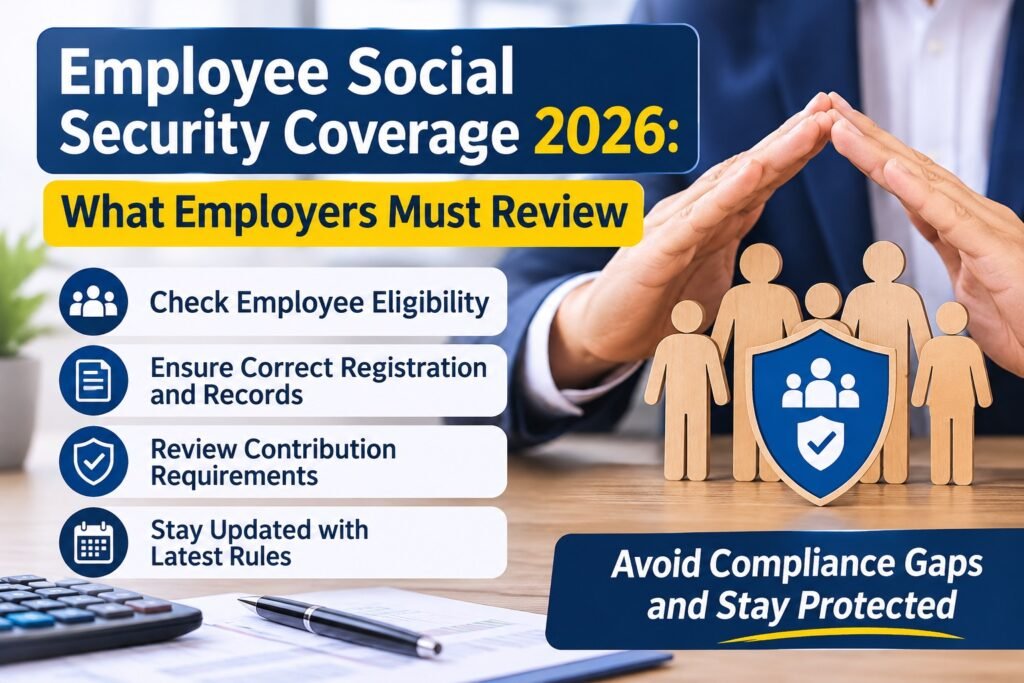
Employee Social Security Coverage 2026: What Employers Must Review
An Employer Compliance Guide to EPF, ESIC, Gratuity, Maternity Benefits, Employee Insurance and Social Security Obligations
Employee social security coverage is one of the most important responsibilities of an employer. Every organisation must ensure that eligible employees receive the statutory social security benefits applicable to their employment.
In 2026, employers should review their employee records, salary structures, statutory registrations, contribution calculations and compliance procedures to ensure that no eligible employee is left outside the applicable social security framework.
Social security compliance is not limited to depositing PF and ESIC contributions every month. It also involves identifying eligible employees, maintaining accurate employment records, completing registrations, submitting returns, updating employee information and ensuring that statutory benefits are provided correctly.
This guide explains the important areas employers should review in 2026.
- What Is Employee Social Security Coverage?
Employee social security coverage refers to statutory benefits and financial protection provided to employees during their employment and after retirement, as applicable under Indian labour and social security laws.
These benefits help employees manage different situations, such as:
- Retirement and long-term savings.
- Medical treatment and hospitalisation.
- Employment-related accidents and injuries.
- Disability or loss of earning capacity.
- Maternity and childcare-related benefits.
- Death-related financial protection for eligible dependants.
- Gratuity and other statutory employment benefits.
For employers, the main responsibility is to identify which employees qualify for each benefit and ensure that all applicable statutory requirements are fulfilled.
- Major Social Security Schemes Employers Must Review in 2026
Employers should review the following statutory schemes and benefit areas:
KEY SOCIAL SECURITY AREAS
Scheme / Benefit | What employers must review |
EPF | Employee eligibility, PF wages and contributions |
EPS | Pension eligibility and contributions |
EDLI | Employee life insurance coverage |
ESIC | Medical and cash benefits eligibility |
Gratuity | Eligibility, service records and liability |
Maternity Benefit | Eligible employees and statutory benefits |
Employees’ Compensation | Workplace injury and occupational accident protection |
Gig and Platform Worker Social Security | Applicable registration and contribution obligations |
- Employees’ Provident Fund (EPF)
The Employees’ Provident Fund is a retirement savings scheme under which eligible employees and employers make statutory contributions.
Important 2026 update: The mandatory EPFO wage ceiling was increased from ₹15,000 to ₹25,000 per month with effect from 17 September 2026. Employers must review the impact of this change on employee eligibility and payroll records.
- Whether all eligible employees are registered under EPFO.
- Whether newly eligible employees have been identified following the revised wage ceiling.
- Whether UAN details are correctly linked with employee records.
- Whether Aadhaar and bank KYC details are updated.
- Whether PF wages are calculated correctly.
- Whether employee and employer contributions are deposited within the applicable deadlines.
- Whether employees’ joining and exit dates are correctly recorded.
Employer’s responsibility: Do not rely on old employee eligibility reports without checking the revised wage ceiling and applicable membership rules.
- Employees’ Pension Scheme (EPS)
The Employees’ Pension Scheme provides retirement and pension-related benefits to eligible EPF members.
Employers should review:
- Employee eligibility for EPS membership.
- Correct allocation of the employer’s contribution between EPF and EPS.
- Employee joining and exit dates.
- Previous employment and pension membership details.
- Pensionable service records.
- Accurate information in EPFO filings.
An incorrect EPS allocation or employment record can create problems when an employee applies for pension benefits.
- Employees’ Deposit Linked Insurance (EDLI)
EDLI provides life insurance protection to eligible EPF members in the event of death while in service, subject to the scheme provisions.
Employers should verify:
- Whether eligible employees are covered.
- Whether EDLI contributions are correctly calculated.
- Whether employee records and nomination details are maintained.
- Whether employment details are updated.
- Whether the organisation is complying with applicable EDLI requirements.
Employers should also ensure that employees understand the importance of maintaining correct nominee information.
- Employees’ State Insurance (ESIC)
ESIC provides medical and cash benefits to eligible insured employees and their dependants.
The benefits include:
- Medical benefits.
- Sickness benefits.
- Maternity benefits.
- Temporary disablement benefits.
- Permanent disablement benefits.
- Dependants’ benefits.
- Funeral expenses, subject to applicable provisions.
What employers must review:
- Whether the establishment is covered under ESIC.
- Whether eligible employees are registered.
- Whether employee insurance numbers are correctly recorded.
- Whether wages are correctly considered for ESIC eligibility.
- Whether contributions are calculated and deposited correctly.
- Whether employee family details and dispensary information are updated.
- Whether workplace accident reports are submitted within the prescribed timeline.
The general ESIC wage ceiling has historically been ₹21,000 per month, with a higher limit for employees with disabilities. Employers should verify the applicable notified ceiling and coverage provisions before processing payroll. The revised EPFO ceiling of ₹25,000 should not automatically be treated as an ESIC ceiling.
- Gratuity Compliance: What Employers Must Review
Gratuity is an important statutory social security benefit payable to eligible employees when their employment ends under qualifying circumstances.
Under the Code on Social Security, 2020, employers should review gratuity obligations in light of the applicable provisions.
Important review areas include:
- Employee service history.
- Date of joining and date of exit.
- Last drawn wages for gratuity calculation.
- Eligible continuous service.
- Fixed-term employment provisions.
- Gratuity liability and financial provisioning.
- Timely calculation and payment.
Employers should not assume that gratuity is applicable only to employees who have completed five years in every situation. Different statutory provisions and exceptions may apply, including in cases of death, disablement and qualifying fixed-term employment.
- Maternity Benefit Compliance
Maternity benefits are an important part of employee social security protection.
Employers must review whether eligible women employees receive statutory maternity benefits and other applicable protections.
The review should include:
- Employee eligibility and qualifying service.
- Maternity leave entitlement.
- Maternity benefit payment.
- Nursing breaks.
- Work-from-home arrangements where applicable.
- Protection against unlawful dismissal during maternity-related absence.
- Crèche facilities where the applicable statutory conditions require them.
Employers should ensure that HR policies and payroll procedures correctly reflect applicable maternity benefit requirements.
- Employees’ Compensation and Workplace Accident Protection
Employers must also review their responsibilities towards employees who suffer injuries, occupational accidents or other qualifying employment-related incidents.
Where applicable, employers should ensure:
- Proper reporting of workplace accidents.
- Maintenance of accident registers.
- Timely submission of statutory reports.
- Correct documentation of injury details.
- Assessment and payment of compensation.
- Appropriate insurance arrangements where required.
- Coordination with ESIC where the employee is covered under the applicable scheme.
An employer should not assume that every workplace accident is covered by the same compensation mechanism. The applicable statutory framework depends on employee coverage and the circumstances of the accident.
- Social Security Coverage for Gig Workers and Platform Workers
One of the significant developments under the Code on Social Security, 2020 is the recognition of gig workers and platform workers.
These categories include workers engaged through digital platforms and app-based services.
Examples include:
- Delivery partners.
- App-based drivers.
- Online service providers.
- Platform-based freelance workers.
The Code provides a framework for social security schemes covering life and disability protection, accident insurance, health benefits, maternity benefits and old-age protection.
Employers and aggregators should review whether their workforce arrangements fall within the applicable definitions and whether any registration, data-sharing or contribution requirements apply.
The government has also introduced an e-Shram registration framework for unorganised workers, including gig and platform workers.
- New Labour Codes 2026: What Has Changed for Employers?
The four Labour Codes came into effect on 21 November 2025. These include:
- Code on Wages, 2019.
- Industrial Relations Code, 2020.
- Code on Social Security, 2020.
- Occupational Safety, Health and Working Conditions Code, 2020.
The Code on Social Security consolidates nine earlier social security legislations into a unified framework.
Some important areas employers should review include:
Compliance area | Employer review |
Social security coverage | Identify eligible employees and workers |
Wage definition | Review applicable wage components |
EPF | Review revised ₹25,000 wage ceiling |
ESIC | Review ₹21,000 notified wage ceiling |
Gratuity | Review revised eligibility and calculation |
Fixed-term employment | Check gratuity eligibility after one year of service |
Gig workers | Review applicable social security obligations |
Employee records | Maintain accurate digital employment records |
The Ministry’s 2026 FAQs also clarify that the ₹21,000 ESIC wage ceiling remains applicable and that the Social Security Code wage definition applies from 21 November 2025.
- Employee Data and Documentation Employers Must Verify
Maintaining accurate employee records is essential for effective social security compliance.
Employers should conduct an employee-wise verification of the following information:
Employee information | What to verify |
Employee name | Correct spelling and personal details |
Date of joining | Accurate joining date |
UAN | Correct PF membership details |
ESIC number | Correct insurance number |
Aadhaar | Correct identification and linking status |
Bank details | Valid account information |
Salary structure | Basic salary, allowances and applicable wages |
Nomination | Updated nominee details |
Employment status | Active, resigned or terminated |
Exit date | Correct date of leaving |
Previous employment | Previous PF and pension membership |
This verification helps reduce errors in statutory filings and employee benefit claims.
- Monthly Social Security Compliance Checklist for Employers
Employers should make social security verification part of their regular payroll process instead of checking everything only during an audit.
Here is a practical monthly checklist:
Employer Social Security Checklist – 2026
Use this checklist during monthly payroll review.
Completion progress
Check newly joined employees for EPF eligibility.
Review the revised EPFO wage ceiling of ₹25,000.
Verify ESIC eligibility and employee insurance numbers.
Check PF and ESIC wage calculations.
Verify employee and employer contribution amounts.
Deposit statutory contributions within applicable due dates.
Update UAN, Aadhaar and bank details.
Verify employee nominations and family details.
Review gratuity liability and employee service records.
Check maternity and workplace accident compliance.
Update employee joining and exit records.
Reconcile payroll records with statutory challans and returns.
- Common Social Security Compliance Mistakes Employers Should Avoid
Even organisations with established HR and payroll departments can make mistakes in statutory compliance.
Some common mistakes include:
- Not reviewing employee eligibility: Employers may continue using outdated employee eligibility records even after changes in statutory wage ceilings.
- Incorrect salary calculations: Incorrect identification of applicable wages can result in underpayment or overpayment of statutory contributions.
- Missing employee registrations: Newly eligible employees may remain unregistered because of incomplete onboarding procedures.
- Incorrect UAN or ESIC details: Errors in employee identification can create difficulties when employees claim their benefits.
- Delayed statutory payments: Late deposits may result in interest, damages or other consequences under applicable law.
- Ignoring contract employees: Employers should review contractor arrangements and verify applicable statutory responsibilities rather than assuming that outsourced employees are automatically outside compliance.
- Not updating employee exit details: Incorrect exit dates can affect PF transfers, withdrawals and other benefit claims.
- Poor documentation: Missing payroll registers, contribution records, accident reports and employee information can create difficulties during inspections and audits.
- Special Compliance Review for Maharashtra Employers
Employers operating in Maharashtra should also review applicable state-level employment and payroll compliance requirements.
In addition to central social security obligations, businesses should examine:
- Maharashtra Professional Tax (PT) registration and payment.
- Maharashtra Labour Welfare Fund (LWF) contributions and returns.
- Applicable leave and holiday records.
- Shops and Establishments registration and compliance, where applicable.
- State-specific labour rules and notifications.
- Contractor and outsourced employee records.
Employers should maintain separate compliance calendars for central and Maharashtra state-level obligations.
The Maharashtra Labour Department provides updates and publications relating to the new Labour Codes and state rules.
- Why Is Social Security Compliance Important for Employers?
Proper social security compliance provides benefits to both employees and organisations.
For employees:
- Financial protection after retirement.
- Access to eligible medical benefits.
- Protection against certain employment-related risks.
- Pension and insurance benefits.
- Maternity and family-related protection.
- Greater financial security.
For employers:
- Better statutory compliance management.
- Reduced risk of penalties and interest.
- Improved employee satisfaction.
- More accurate payroll processing.
- Better employee record management.
- Reduced compliance-related disputes.
- Improved organisational reputation.
- Final Employer Action Plan for 2026
Before closing the monthly payroll or conducting an annual compliance audit, employers should undertake a complete review of employee social security coverage.
The following action plan can help:
Priority | Action required |
High | Review the revised EPFO wage ceiling |
High | Identify all eligible EPF and ESIC employees |
High | Verify statutory contribution calculations |
High | Check pending statutory payments |
Medium | Update employee KYC and nomination details |
Medium | Review gratuity provisions and liabilities |
Medium | Verify contractor compliance |
Medium | Review maternity and accident-related records |
Regular | Reconcile payroll and statutory records |
Conclusion
Employee social security coverage is not just a statutory formality. It is an essential part of responsible employment management.
In 2026, employers must pay particular attention to revised EPFO coverage, ESIC eligibility, employee registration, wage calculations, gratuity provisions and the implementation of the new Labour Codes.
A proper social security audit helps organisations identify compliance gaps, correct employee records and ensure that eligible employees receive the benefits available under applicable laws.
Employers should therefore make employee social security verification a regular part of their HR, payroll and statutory compliance activities.
Need help with ITR filing or PF withdrawal?
Talk to an Expert →