
1.Introduction of EPFO
The Employees’ Provident Fund Organisation (EPFO) has introduced several significant reforms in 2026 aimed at making provident fund services faster, more transparent, and more user-friendly. These changes are part of India’s larger vision of modernizing social security benefits under the Code on Social Security, 2020.
With millions of employees and employers depending on EPFO services for provident fund contributions, pension benefits, and claim settlements, these latest developments are expected to improve the overall experience and reduce administrative delays.
From the launch of the new EPF Scheme 2026 to faster claim settlements and a centralized digital platform, EPFO is moving toward a completely digital and efficient ecosystem.
- Introduction of the New EPF Scheme 2026
One of the biggest changes introduced in 2026 is the implementation of the Employees’ Provident Funds Scheme, 2026, replacing the long-standing EPF Scheme of 1952.
The new scheme aligns provident fund regulations with the provisions of the Code on Social Security, 2020 while retaining the core benefits available to employees.
Although the structure of employee and employer contributions remains unchanged, the new framework focuses heavily on:
~Simplification of rules and procedures.
>Increased digitization of services.
>Faster claim processing.
>Improved transparency and accountability.
>Better integration between EPF, EPS, and EDLI schemes.
For existing EPF members, there is no requirement to open new accounts or complete additional registrations. Their existing Universal Account Number (UAN) and PF accounts continue to remain valid
The introduction of this scheme marks one of the most important reforms in India’s social security system in recent years.
- EPF Interest Rate Retained at 8.25%
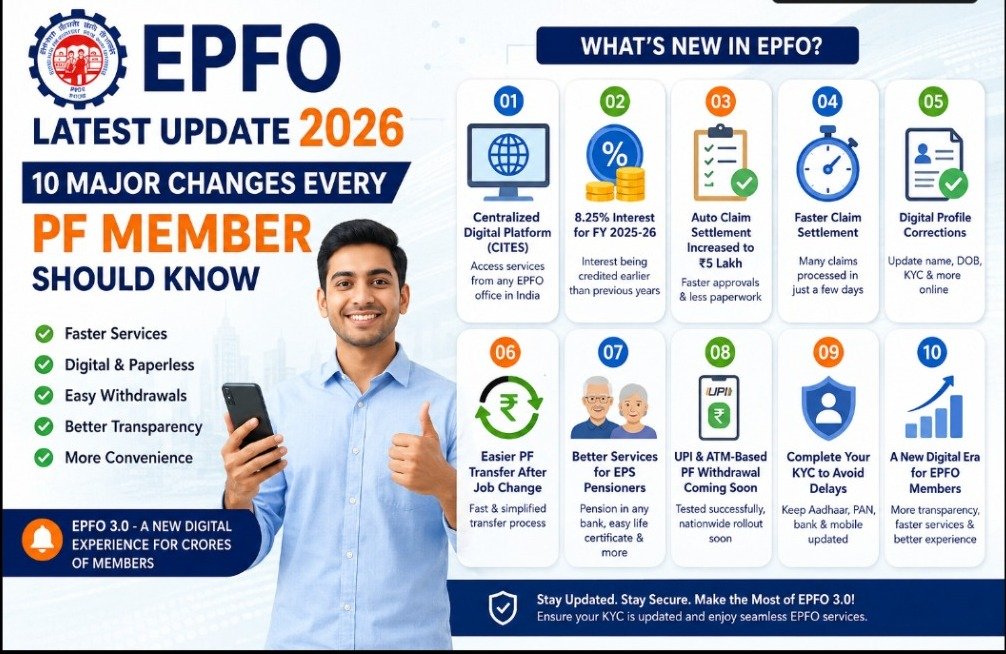
The Central Board of Trustees has retained the EPF interest rate at 8.25% for FY 2025-26.
This decision provides stability and reassurance to millions of employees who rely on provident fund savings as a major component of their retirement corpus.
Despite changing market conditions and fluctuating interest rates in the banking sector, EPFO has maintained the same interest rate to safeguard employee savings.
~For employees this means:
>Continued growth of retirement savings.
>Better long-term financial planning.
>Higher returns compared to many traditional savings instruments.
>Security backed by the Government of India.
EPFO has also begun crediting interest amounts directly into member accounts, and updated balances are expected to reflect in passbooks quickly through the upgraded digital system.
- Faster PF Claim Settlement
Traditionally, PF withdrawal claims often required manual verification and lengthy processing periods.
To improve service delivery, EPFO has expanded its auto-settlement facility and increased the claim limit for automatic processing to ₹5 lakh for eligible advance claims.
This is a major relief for employees requiring urgent financial assistance for:
>Medical emergencies
>Education expenses
>Marriage expenses
>Housing requirements
>Other eligible advance withdrawal purposes
Under the new system, eligible claims can now be processed within approximately three days, significantly reducing waiting periods.
~Benefits of faster claim processing include:
>Reduced dependency on physical visits to EPFO offices.
>Immediate financial support during emergencies.
>Improved employee satisfaction.
>Greater transparency in claim tracking.
This reform represents one of the most practical and employee-friendly initiatives introduced by EPFO.
- Launch of EPFO 3.0 and Centralized Digital Platform
EPFO has launched a major digital transformation initiative popularly known as EPFO 3.0.
The organization has implemented a centralized IT-enabled system designed to create a single database for all members across India.
Earlier, many services were linked to specific regional offices, causing delays and administrative complications.
~The new centralized platform offers:
>Unified member records.
>Faster processing of requests.
>Improved KYC verification.
>Better tracking of claims and applications.
>Reduced paperwork.
>Improved user experience.
The system is expected to minimize manual intervention and improve efficiency across all EPFO operations.
This transformation will benefit both employees and employers by making compliance procedures simpler and quicker.
6. Nationwide Access to EPFO Services
Under the earlier structure, employees often faced difficulties when changing jobs or moving to another city because services were linked to a particular EPFO office.
With the implementation of the centralized system, members can now access services from any EPFO office in India.
~This means employees can:
-Submit requests from any location.
-Receive support irrespective of their registered office jurisdiction.
-Avoid unnecessary regional office visits.
-Experience faster grievance resolution.
This is particularly beneficial for employees working in sectors such as IT, banking, manufacturing, and staffing where job mobility is high.
- Simplified PF Transfer Process
Changing jobs is a common part of professional life, and PF transfer has historically been one of the most challenging aspects for employees.
EPFO has now simplified the transfer process considerably.
~Under the upgraded digital system:
-Separate transfer forms may no longer be required in many cases.
-Transfers are becoming increasingly automated.
-Member data is centrally available.
-Processing delays are expected to reduce substantially.
For employers and HR departments, this means less paperwork and fewer employee grievances related to PF transfers.
For employees, it means easier continuity of retirement savings without administrative hurdles.
- What Do These Updates Mean for Employees?
The latest EPFO reforms make managing your provident fund easier than ever. Employees can expect:
-Faster claim settlements
-Easier job-to-job PF transfers
-Improved online services
-Greater transperancy
-Better access to retirement savings information
- What Do These Updates Mean for Employers?
Employers also benefit from streamlined compliance and digital processes including:
>Simplified EPF administration
>Faster employee onboarding
>Better payroll integration
>Reduced paperwork
>Improved compliance management
Need help with ITR filing or PF withdrawal?
Talk to an Expert →