
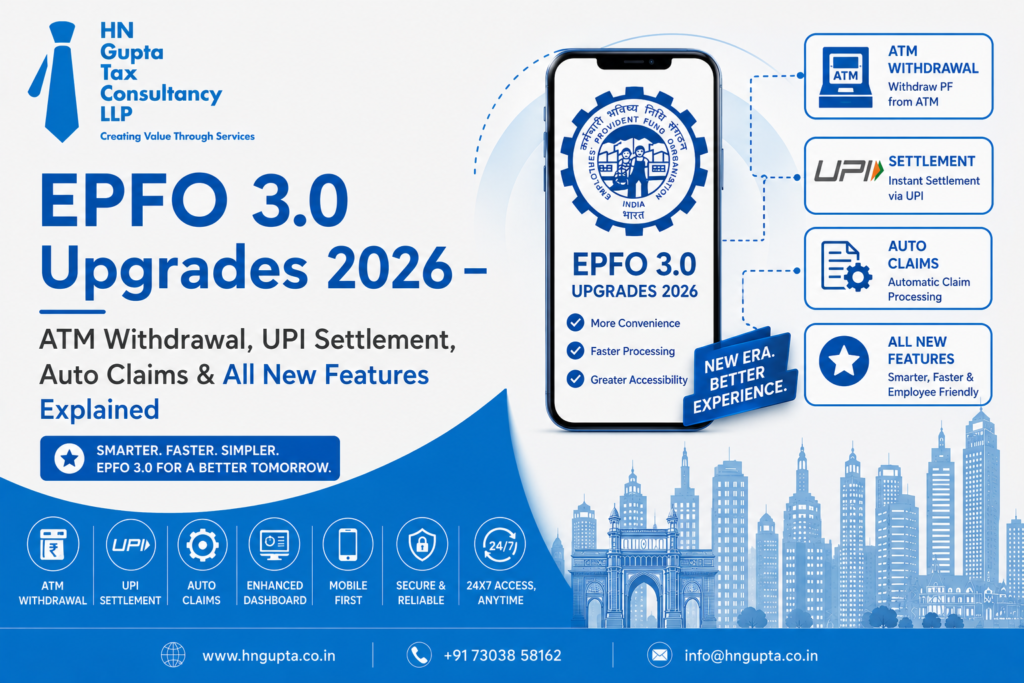
The Employees' Provident Fund Organisation is in the middle of the most ambitious transformation in its 70-year history. EPFO 3.0 — the organisation's landmark digital overhaul — is changing how 6.5 crore active members and 7 crore pensioners interact with their PF accounts. From withdrawing money via ATM to receiving settlement via UPI within hours, from automated claim processing to digital life certificates — the experience of accessing PF money in 2026 is fundamentally different from what it was even 2 years ago.
This guide by HN Gupta & Co., Mumbai, covers every major EPFO 3.0 upgrade — what it is, how it works, and what it means for you as an employee or employer in Mumbai.
Section 1: What is EPFO 3.0 and Why It Matters
EPFO 3.0 is a comprehensive digital transformation programme that builds on two previous phases — EPFO 1.0 (online ECR filing and basic member portal) and EPFO 2.0 (UAN, Aadhaar linking, online claims). The third phase goes significantly further — it targets the complete elimination of manual processing, employer dependency, and regional silos that have historically made PF access slow and frustrating.
The Core Problems EPFO 3.0 Solves
- Old EPFO required employer involvement for almost every member service — KYC approval, claim attestation, exit date updates. If an employer was unresponsive or the company had shut down, the employee was locked out of their own money.
- Settlement under the old system took 20 to 45 working days for even straightforward claims. Backend processing was largely manual — officers reviewing each claim individually.
- Regional fragmentation meant a member who worked in Mumbai could face processing delays if their employer's records were under a different regional office's jurisdiction.
EPFO 3.0 solves all three — centralising the database, automating processing, and making member services available directly without employer intermediation.
Section 2: ATM-Based PF Withdrawal — The Headline Feature
What It Is
ATM-based PF withdrawal allows members to physically draw PF advance amounts from an ATM — the same way they would withdraw from a savings account. No online portal. No form filling. No waiting.
How It Works
- Your UAN-linked bank account at a participating bank is enabled for PF advance access.
- Your existing debit card (or a dedicated PF card) allows you to draw from your eligible PF advance limit at the ATM.
- Authentication uses your ATM PIN plus Aadhaar biometric — fingerprint or face — at the ATM terminal.
- The withdrawal simultaneously triggers a PF advance claim in EPFO's system.
Banks Currently in Pilot
State Bank of India, Punjab National Bank, Bank of Baroda, and Canara Bank are the primary pilot partners. Mumbai is a priority city for expansion given its large EPF member base.
What You Can Withdraw
The ATM facility is for PF advance — primarily emergency purposes — not for full settlement after resignation. The withdrawal limit is the lower of 6 months of Basic + DA or total employee contribution with interest. Standard bank daily ATM cash limits also apply.
Security
- PIN plus Aadhaar biometric (fingerprint or face) at ATM terminal.
- Daily transaction limits.
- Instant SMS alert to registered mobile for every transaction.
- Ability to freeze PF ATM access from the member portal.
Current Status
Active pilot phase in 2026. Mumbai is in the priority expansion list. Full rollout progressing through 2026. Check epfindia.gov.in for current availability at specific banks and ATMs.
Section 3: UPI-Based PF Settlement — Already Live
While ATM withdrawal is still rolling out — UPI-based PF settlement is already fully operational and available to eligible members right now.
What Changed
When your PF claim is approved, the settlement amount can now be pushed directly to your UPI ID within hours — compared to the 24 to 48 hours NEFT transfer that was previously standard. For members whose complete KYC is approved and claims go through automated processing, the end-to-end experience from submission to money in account can be as short as 24 hours.
How to Use UPI for PF
- Ensure your EPFO-seeded bank account is UPI-enabled at your bank.
- When filing your claim on the EPFO member portal, look for the UPI payment option in the payment details section.
- Enter your UPI ID.
- Submit claim with Aadhaar OTP.
- Once approved, amount is pushed to your UPI ID.
UPI Limits
NPCI's standard UPI per-transaction limit applies. For larger settlement amounts — full EPF corpus of several lakhs — payment is automatically routed via RTGS which also settles in real time during banking hours. Most partial advance claims fall within UPI limits.
Pre-Requisite for Fast UPI Settlement
- UAN active.
- Aadhaar KYC approved.
- PAN linked and approved (mandatory above ₹50,000).
- Bank account verified.
- For full settlement — employer must have updated your Date of Exit on EPFO portal.
Section 4: Straight-Through Processing — Auto Claim Settlement
Straight-Through Processing (STP) is the quiet revolution inside EPFO 3.0 that is making the biggest difference in settlement speed.
What STP Means
In the old system — every claim was reviewed manually by an EPFO officer. Even a simple partial advance claim could sit in a queue for weeks. Under STP, EPFO's backend algorithms automatically verify eligibility, validate documents, approve, and trigger payment — without any human officer involvement.
How It Works
- Member submits claim with Aadhaar OTP authentication.
- System runs automated checks — UAN active? Aadhaar verified? PAN linked? Bank account approved? Exit date updated (for full settlement)? Waiting period complete? Eligibility conditions met? Documents valid?
- If all checks pass — claim is auto-approved and payment is triggered.
- Total time: often within 24 to 72 hours.
Which Claims Get STP
- Partial advance claims (Form 31) for medical, marriage, education, and housing where all conditions are met.
- Full EPF settlement (Form 19) where exit date is updated, 2-month waiting period is complete, and all KYC is approved.
- EPS withdrawal (Form 10C) for members with under 10 years service where records are clean.
Auto-Settlement at Retirement
EPFO's newest automation — when a member turns 58 (EPF retirement age), the system automatically sends a notification to the registered mobile number and, if all KYC is complete, processes the full EPF settlement without the member needing to file any form. Completely proactive — the member does not need to know the process or initiate anything.
What Still Goes to Manual Queue
- Claims with incomplete or mismatched KYC.
- Exit date not updated by employer.
- Name mismatch between Aadhaar and EPFO records.
- Large claims flagged by fraud detection algorithms.
- Deceased member claims (require manual verification of documents).
Section 5: Centralised Pension Payment System (CPPS)
The Centralised Pension Payment System is one of the most impactful EPFO 3.0 upgrades for the 7+ crore EPS pensioners — and it is already fully live.
The Old Problem
EPS pension payments were managed by the specific EPFO regional office under whose jurisdiction the pensioner's service record fell. The pension was paid through a designated bank branch tied to that office. If a pensioner moved cities after retirement — say, from Mumbai to their hometown in another state — pension payment was disrupted. A cumbersome Pension Payment Order (PPO) transfer had to be filed. This could take months and left senior citizens without pension during the process.
What CPPS Changed
All EPS pension payments are now centralised on a single national platform. Every pensioner's pension is linked to their Aadhaar and bank account — and is credited on a uniform date every month regardless of where they live. A Mumbai pensioner who retires to Nagpur, Pune, or any city in India continues receiving pension in the same bank account without filing any documentation.
Digital Life Certificate — No Bank Visit Required
The annual Jeevan Pramaan Patra (life certificate) — which previously required elderly pensioners to physically visit a bank branch — can now be submitted through:
- The Jeevan Pramaan app on any Android smartphone using Aadhaar fingerprint or face authentication.
- UMANG app with Aadhaar biometric.
- Common Service Centres (CSCs) across every ward in Mumbai.
- Doorstep banking service for senior citizens at major public sector banks.
For Mumbai pensioners — check your pension payment details on the EPFO member portal to confirm your account has been migrated to CPPS. If not yet migrated, contact EPFO helpline 1800-118-005.
Section 6: Aadhaar Face Authentication
One of the most practically impactful new additions to EPFO 3.0 is Aadhaar face authentication — and it directly solves a problem that has affected millions of blue-collar workers across India.
The Problem it Solves
Fingerprint biometric authentication fails for a significant percentage of workers in manual labour, construction, garment manufacturing, and domestic services — professions where fingerprints wear down over time due to physical work. For these members, repeated authentication failures blocked access to PF claims, digital life certificates, and other EPFO services.
Face authentication — using the front camera of a smartphone — works regardless of fingerprint quality.
How to Use
- Download the Aadhaar Face RD app from Google Play Store.
- Link it with your Aadhaar.
- When prompted for biometric authentication during EPFO claim submission or life certificate filing — select face authentication instead of fingerprint.
- Position face in front of camera as instructed.
- Authentication completes within seconds.
Where Face Auth Works
- Online PF claims on EPFO member portal.
- Digital Life Certificate submission for EPS pensioners.
- ATM-based PF withdrawal (at supporting ATM terminals).
- EPFO facilitation centre verification.
Section 7: New Member Portal and UMANG App Upgrades
The EPFO member portal and UMANG app have been significantly upgraded as part of EPFO 3.0. Here is what is new:
Updated Member Portal (unifiedportal-mem.epfindia.gov.in)
- Unified dashboard — one screen shows your total EPF balance, EPS service period, all pending claims with current status, KYC status for all documents, recent transactions, and quick action buttons.
- Real-time KYC status — Aadhaar, PAN, and bank account status visible at a glance. No more navigating to separate screens.
- Document validation before submission — the portal now validates document size, format, and legibility in real time. You are told immediately if a document will be rejected before you submit.
- Integrated grievance filing — file a grievance directly about a specific claim with one click — no need to switch to a separate portal.
- DigiLocker integration — your PF passbook, UAN card, and claim settlement letters are available as verified documents on DigiLocker and shareable instantly.
- Multiple account consolidation — members with PF accounts under multiple UANs can request consolidation directly from the portal.
Updated UMANG App
- One-tap balance check without full login.
- Real-time claim status with stage-by-stage tracking.
- Push notifications for claim updates.
- KYC status dashboard.
- Integrated grievance filing.
- WhatsApp-based EPFO helpdesk for basic queries — balance, claim status, and grievance filing via WhatsApp.
Section 8: What EPFO 3.0 Means for Employers in Mumbai
EPFO 3.0 is not just a member-facing upgrade. Employers in Mumbai face specific implications:
Faster Detection of Compliance Gaps
EPFO's new AI-based monitoring system cross-references employer ECR data with GST filings and income tax returns in real time. Anomalies — inconsistent wage reporting, missing employee coverage, sudden headcount changes — are automatically flagged for inspection. Compliance gaps that previously went undetected for months or years are now being caught much faster.
Higher Accountability for KYC
With faster claim processing dependent entirely on KYC approval status, employers who delay approving employee Aadhaar and bank account KYC on the employer portal create immediate problems for employees. This directly generates EPFO grievances against the employer. Make KYC approval part of Day 1 joining formalities.
Exit Date Updates are Non-Negotiable
Under the old system, delayed exit date updates caused employee frustration but often went unaddressed. Under EPFO 3.0, employees file grievances within days of discovering the missing update — and the automated grievance system escalates these quickly. Update exit dates within 7 days of an employee's last working day.
Enhanced Employer Portal
The EPFO employer portal has been upgraded with faster ECR filing, bulk data upload, real-time ECR validation, and automated contribution reconciliation — making the monthly compliance process faster for employers who use it correctly.
Section 9: Frequently Asked Questions
Is ATM PF withdrawal available in Mumbai right now?
It is in active pilot phase with select public sector banks. Mumbai is a priority expansion city. Check epfindia.gov.in for current bank partner list and ATM locations. Full rollout is progressing through 2026.
How fast is PF withdrawal under EPFO 3.0?
For members with complete KYC — Aadhaar, PAN, and bank account all Approved — and an eligible claim, settlement under EPFO 3.0's STP system happens in 24 to 72 hours. With UPI payment, money arrives within hours of settlement approval.
I am an EPS pensioner in Mumbai. What do I need to do for CPPS?
Log in to the EPFO member portal and check your pension payment details. If your pension has already been migrated to CPPS, you are covered — your pension will continue at any bank anywhere. If not yet migrated, call EPFO helpline 1800-118-005 or visit EPFO Mumbai office at BKC (Mumbai-II) or LBS Road (Mumbai-I).
My fingerprint authentication always fails. Can I use face auth for my PF claim?
Yes. Download the Aadhaar Face RD app from Google Play. When prompted for biometric during claim submission, select face authentication. This is now formally approved by EPFO as a valid authentication method.
My employer has not approved my Aadhaar KYC. What should I do?
Contact your HR team in writing requesting immediate KYC approval on the EPFO employer portal. If unresponsive within 7 days, file a grievance on epfigms.gov.in. Pending KYC blocks all fast-track claim processing under EPFO 3.0.
Need help with ITR filing or PF withdrawal?
Talk to an Expert →