
TITLE: ESIC: Eligibility, Contribution Rates, Benefits & Employer Compliance Guide
ESIC (Employees’ State Insurance Corporation) is an important social security organisation in India that provides health insurance and social security benefits to eligible employees and their families. The scheme operates under the Employees’ State Insurance Act, 1948 and is particularly important for employers, HR teams and payroll professionals.
ESIC provides financial and medical support to insured employees during situations such as sickness, maternity, employment injury, disablement and death due to employment-related injuries.
1. What is ESIC?
The Employees’ State Insurance Scheme is a contributory social security scheme administered by ESIC. Both the employer and eligible employee contribute to the scheme every month.
The main objective of ESIC is to provide employees with access to medical treatment and financial assistance when they are unable to work because of sickness, maternity or employment injury.
The scheme can cover not only the insured employee but also eligible family members for medical benefits.
2. Who is Eligible for ESIC?
~ESIC coverage generally depends on two main factors:
• The establishment must fall within the coverage of the ESI Act.
• The employee’s wages must be within the prescribed wage ceiling.
The standard wage ceiling for ESIC coverage is ₹21,000 per month. For employees with disabilities, the wage ceiling is ₹25,000 per month.
~ESIC coverage may apply to establishments such as:
• Factories
• Shops and commercial establishments
• Hotels and restaurants
• Road transport establishments
• Private educational institutions
• Other establishments covered through government notification
The employee-count threshold can vary depending on the applicable notification and establishment category.
3. ESIC Contribution Rates
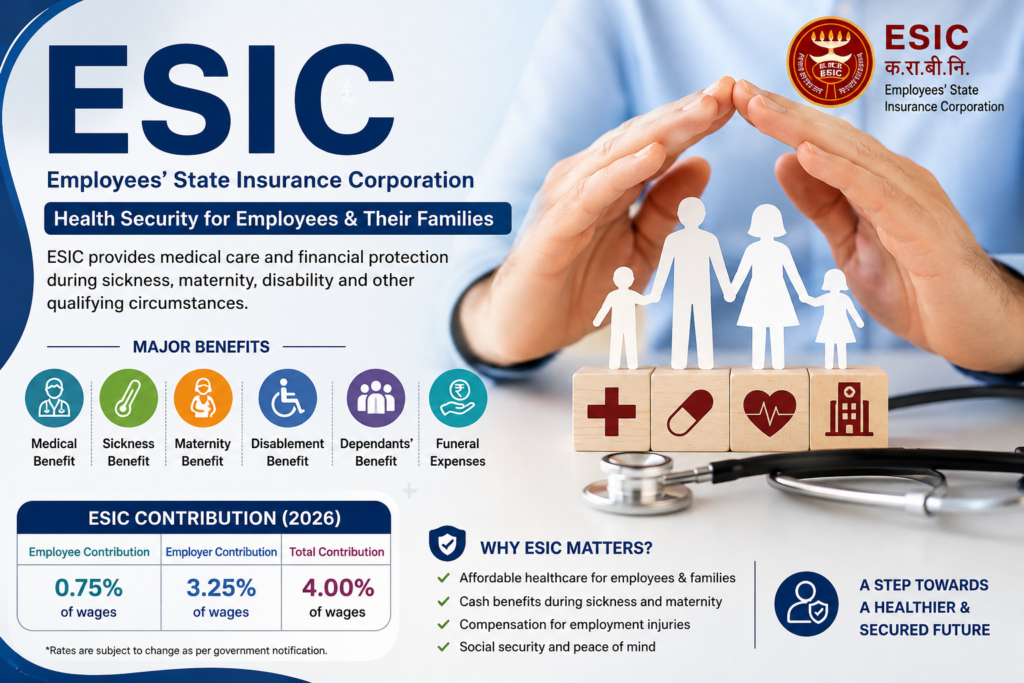
The current ESIC contribution rates are:
-Contribution Rate
Employee contribution
0.75%
Employer contribution
3.25%
Total contribution
4.00%
~For example, if an employee’s applicable ESIC wages are ₹20,000 per month:
• Employee contribution = ₹20,000 × 0.75% = ₹150
• Employer contribution = ₹20,000 × 3.25% = ₹650
• Total contribution = ₹800
The employee’s contribution is normally deducted from salary, while the employer deposits both the employee and employer contributions with ESIC.
4. Major Benefits Under ESIC
ESIC provides several types of benefits to insured persons and their eligible family members.
-Medical Benefit
Insured employees and eligible family members can receive medical treatment through the ESI healthcare network. Depending on eligibility and applicable rules, this can include consultations, medicines, diagnostic services, specialist treatment and hospitalisation.
–Sickness Benefit
An eligible insured person may receive cash compensation during certified periods of sickness, subject to the applicable contribution and benefit conditions.
-Maternity Benefit
Eligible insured women can receive maternity-related benefits under the ESI Scheme, including cash benefits for the prescribed period and medical care.
-Disablement Benefit
When an insured employee suffers an employment injury, ESIC can provide benefits for temporary or permanent disablement, subject to the applicable rules and medical assessment.
-Dependants’ Benefit
If an insured person dies as a result of an employment injury, eligible dependants may receive periodic payments under the dependants’ benefit provisions.
-Funeral Expenses
A prescribed amount may be provided towards funeral expenses of a deceased insured person, subject to the applicable conditions.
5. ESIC Registration for Employers
Employers covered under the ESI Act are required to complete ESIC registration and comply with the applicable requirements.
~The general process involves:
1. Registering the establishment with ESIC.
2. Obtaining the employer code.
3. Registering eligible employees.
4. Providing the required employee and family details.
5. Maintaining accurate employee and wage records.
6. Calculating monthly contributions.
7. Filing the required contribution details.
8. Paying the ESIC contribution within the prescribed time.
6. ESIC Compliance Responsibilities of Employers
For HR and payroll teams, regular ESIC compliance is important.
`Employers should ensure:
• Correct identification of employees covered under ESIC.
• Accurate calculation of ESIC wages.
• Correct deduction of the employee’s contribution.
• Correct calculation of the employer’s contribution.
• Timely payment of contributions.
• Accurate employee and family details.
• Proper maintenance of payroll and contribution records.
• Timely reporting of relevant changes in employee information.
Errors in employee details or contribution calculations can create problems while employees are trying to access ESIC benefits.
7. What is ESIC Insurance Number?
Every registered insured employee receives a unique ESIC Insurance Number. This number remains associated with the insured person and is used for accessing benefits under the scheme.
Employees should ensure that their personal information, nominee/family details and other relevant records are correctly maintained.
8. ESIC vs EPF
ESIC and EPF are both important employee-benefit systems, but their purposes are different.
Particular
ESIC
EPF
Main purpose
Health and social security
Retirement savings
Administered by
ESIC
EPFO
~Employee contribution
0.75%
Generally 12%
-Employer contribution
3.25%
Generally 12%
~Major benefits
Medical, sickness, maternity, disablement, dependants’ benefits
Provident fund, pension and related benefits
In simple terms, ESIC primarily provides healthcare and social security protection, while EPF primarily helps employees build retirement savings.
9. Why ESIC Compliance is Important
ESIC compliance is important for both employers and employees. For employees, the scheme provides valuable medical and financial protection during difficult situations.
For employers, timely compliance helps avoid issues related to contribution payments, employee registration, records and statutory requirements.
~HR and payroll departments should therefore regularly review:
• Employee eligibility
• Wage details
• ESIC deductions
• Employer contributions
• Monthly payment records
• Employee insurance details
• Changes in employee status
Need help with ITR filing or PF withdrawal?
Talk to an Expert →