
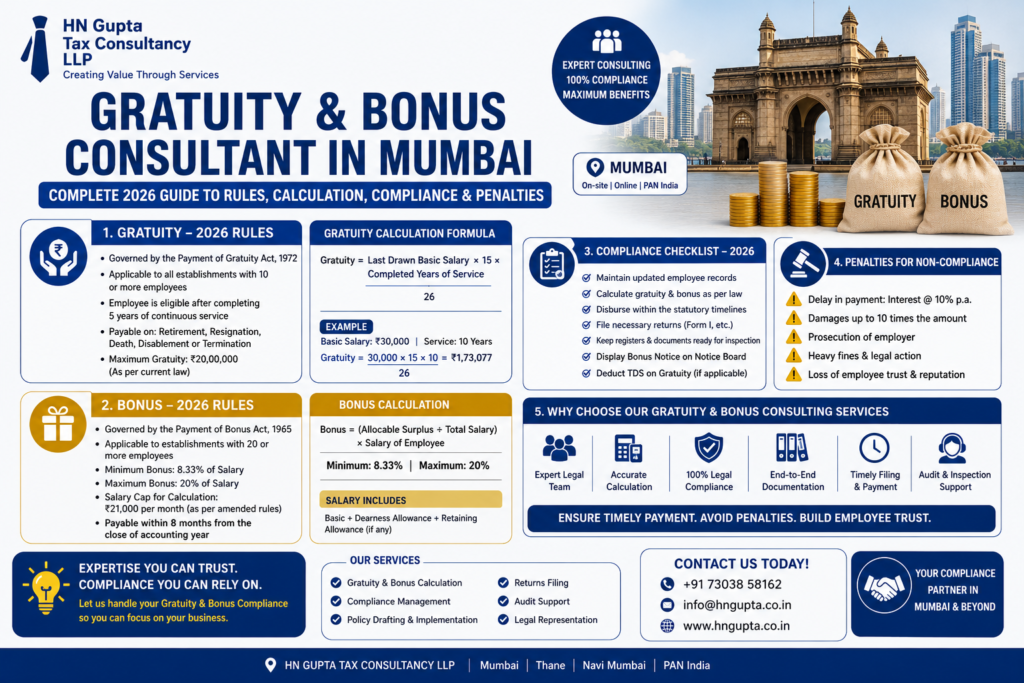
For every business in Mumbai that has employees — two statutory obligations sit quietly in the background, building liability month after month: Gratuity under the Payment of Gratuity Act, 1972, and Statutory Bonus under the Payment of Bonus Act, 1965.
Many Mumbai businesses treat both as back-office afterthoughts — to be dealt with only when an employee leaves or when the Diwali season arrives. This is a costly approach. Late gratuity payment attracts 10% interest per annum. Non-payment of statutory bonus carries criminal prosecution. Both can trigger Labour Court complaints and inspector visits that expose far broader compliance gaps.
This complete guide by HN Gupta & Co., Mumbai, covers everything you need to know about gratuity and bonus rules, calculations, deadlines, tax treatment, and how expert advisory helps Mumbai businesses stay protected.
Section 1: Gratuity — What It Is and Who Must Pay
Gratuity is a statutory lump sum payment made by an employer to an employee as a token of appreciation for long service. It is governed by the Payment of Gratuity Act, 1972, and is mandatory for every establishment in Mumbai that has 10 or more employees.
Once an establishment reaches 10 employees, it remains covered under the Act permanently — even if the workforce later falls below 10.
Gratuity is Payable On
- Resignation after completing qualifying service.
- Retirement at superannuation.
- Death of the employee (paid to nominee or legal heir).
- Permanent disablement due to accident or disease.
Section 2: Gratuity Eligibility Rules 2026
5-Year Service Requirement
The standard rule is that an employee must complete at least 5 years of continuous service to be eligible for gratuity on resignation or retirement.
Important Court Ruling on 4 Years 240 Days
Multiple High Court rulings — including judgments relevant to Mumbai — have held that an employee who completes 4 years and 240 days of service is considered to have completed 5 years for gratuity eligibility. This is because the working year for gratuity purposes counts 240 working days as one full year for employees working in establishments operating 6 days a week.
Many Mumbai employers are unaware of this and deny gratuity to employees who leave just before completing exactly 5 calendar years — which can be challenged legally.
No Minimum Service for Death or Disability
In case of death or permanent disablement, gratuity is payable regardless of how many years the employee has served — even if they worked for just 6 months.
Fixed Term Employees
Under the new Labour Codes framework, fixed-term employees who complete at least 1 year of service are entitled to gratuity — even if their contract ends. Mumbai businesses using fixed-term arrangements must factor this into their payroll planning.
Section 3: Gratuity Calculation Formula with Examples
Standard Gratuity Formula
Gratuity = (Last Drawn Basic Salary + DA) × 15 × Years of Service ÷ 26
Where 15 represents 15 days of wages per year of service, and 26 represents the number of working days in a month.
Example 1 — Employee with ₹30,000 Basic Salary and 8 Years Service
Gratuity = ₹30,000 × 15 × 8 ÷ 26 = ₹1,38,461
Example 2 — Employee with ₹50,000 Basic Salary and 15 Years Service
Gratuity = ₹50,000 × 15 × 15 ÷ 26 = ₹4,32,692
Maximum Gratuity Limit
The maximum gratuity payable under the Act is currently ₹20 lakhs. Any amount above ₹20 lakhs can be paid voluntarily as ex-gratia but is not legally mandated. The ₹20 lakh ceiling has been in effect since March 2018 and there are ongoing discussions to revise it upward, though no official notification has been issued as of June 2026.
What Counts as Salary for Gratuity
Gratuity is calculated on Basic Salary + Dearness Allowance only — not on gross salary, not on HRA, not on incentives or other allowances. This is one of the most common calculation errors made by Mumbai businesses.
Section 4: Gratuity Payment Deadlines and Penalties
Payment Timeline
Gratuity must be paid within 30 days from the date it becomes payable — typically the last working day of the employee for resignation and retirement cases.
Employer's Notice Obligation
The employer must respond to the employee's gratuity claim within 15 days — either acknowledging the amount due or disputing it with valid reasons. Silence is not an option.
Penalty for Late Payment
If gratuity is not paid within 30 days, the employer is liable to pay simple interest at 10% per annum on the outstanding gratuity amount from the date it became payable to the date of actual payment. This interest is payable without any formal court order — it is automatic under the Act.
Criminal Prosecution
Under Section 9 of the Payment of Gratuity Act, wilful non-payment of gratuity — or payment of less than the due amount — can result in imprisonment of 6 months to 2 years and fine. For false statements in gratuity records, imprisonment up to 6 months or fine up to ₹10,000 applies.
Controlling Authority
In Mumbai, the controlling authority for gratuity disputes is the Labour Commissioner, Maharashtra. Employees can file claims for unpaid gratuity directly before the Controlling Authority without a lawyer.
Section 5: Tax Treatment of Gratuity
For Employees in Private Sector
Tax exemption is available on gratuity received — up to ₹20 lakhs for private sector employees (aligned with the statutory maximum). This limit was revised upward from ₹10 lakhs.
- Gratuity received up to ₹20 lakhs is fully exempt from income tax.
- Amount above ₹20 lakhs (if paid as voluntary ex-gratia) is taxable as salary income.
For Government Employees
Gratuity received by central and state government employees is fully exempt from income tax — no upper limit.
On Death of Employee
Gratuity paid to the legal heirs or nominees of a deceased employee is fully tax-free — no limit applies.
Employer Treatment
From the employer's perspective, annual gratuity provision (accrual) is deductible as a business expense if paid into an approved gratuity fund or computed and disclosed in accounts. Businesses with 10+ employees are advised to obtain group gratuity insurance from LIC or private insurers to fund gratuity liability and also benefit from tax deduction on premium paid.
Section 6: Statutory Bonus — What It Is and Who Must Pay
The Payment of Bonus Act, 1965, mandates that employers pay an annual bonus to eligible employees. It applies to every establishment in Mumbai with 20 or more employees.
Once covered, the establishment remains covered even if the workforce later falls below 20.
Who Receives Bonus
Every employee who has worked in the establishment for at least 30 working days in an accounting year and earns a salary or wage up to ₹21,000 per month in gross wages is entitled to bonus.
Section 7: Bonus Eligibility and Calculation Rules 2026
Eligible Salary Range
Employees earning up to ₹21,000 per month in gross wages are eligible for bonus. This threshold has been in place since 2016.
Calculation Base — Salary Capped at ₹7,000
For bonus calculation, salary is capped at ₹7,000 per month or the applicable minimum wage for the relevant industry and area — whichever is higher. Even if an employee earns ₹20,000 per month, bonus is calculated on ₹7,000 (or higher minimum wage if applicable).
Minimum Bonus
8.33% of the annual salary (capped at ₹7,000/month) — or ₹100 per year, whichever is higher. This is the statutory floor — payable even if the employer makes no profit.
Maximum Bonus
20% of the annual salary (capped at ₹7,000/month). The actual bonus rate between 8.33% and 20% depends on the establishment's allocable surplus for the year.
Example — Bonus Calculation
Employee earning ₹18,000/month gross, Mumbai applicable minimum wage above ₹7,000:
- Minimum bonus = 8.33% × (₹7,000 × 12) = 8.33% × ₹84,000 = ₹7,000 per year.
- Maximum bonus = 20% × ₹84,000 = ₹16,800 per year.
Section 8: Bonus Payment Deadlines and Penalties
Payment Timeline
Statutory bonus must be paid within 8 months from the close of the accounting year. For most Mumbai businesses with an April to March financial year — bonus must be paid by November 30 of the following year. Customarily in Mumbai, bonus is paid before or around Diwali — which falls within this window.
Annual Return Filing
An annual bonus return must be filed with the Labour Department under Form D within 30 days of the payment — by December 31 for most businesses.
Penalties for Non-Payment
Under Section 28 of the Payment of Bonus Act — wilful non-payment of bonus or paying less than the minimum due carries imprisonment up to 6 months and/or fine up to ₹1,000. The employee can also approach the Labour Authority for recovery of the unpaid amount with interest.
Contesting Bonus
An employer who believes the establishment made insufficient profits can contest the minimum bonus claim — but this requires maintaining proper books of accounts and computed allocable surplus statements. Unaudited or unverifiable accounts are not accepted by the Labour Authority.
Section 9: Tax Treatment of Bonus
For Employees
Statutory bonus received by an employee is fully taxable as salary income under the Income Tax Act. It is included in the gross salary for TDS computation in the month it is paid. The employer must deduct TDS on bonus at the applicable income tax slab rate of the employee.
For Employers
Bonus paid to employees is a legitimate business expense and fully deductible from the employer's taxable income in the year of payment — provided it is paid within 30 days of the due date of the income tax return for that year. Bonus provisions in accounts (accrued but not yet paid) are not deductible — only actual payment qualifies.
Frequently Asked Questions
Can an employee claim gratuity if they resign before completing exactly 5 years?
Under court rulings including those applicable in Mumbai, completing 4 years and 240 days of continuous service is treated as completing 5 years for gratuity eligibility. Employees in this situation who were denied gratuity can approach the Controlling Authority (Labour Commissioner, Maharashtra) for recovery.
Does statutory bonus apply to all employees in our Mumbai office?
Bonus under the Payment of Bonus Act applies to employees earning up to ₹21,000 per month in gross wages, who have worked at least 30 working days in the accounting year, and whose establishment has 20 or more employees. Employees above ₹21,000 gross are excluded from statutory bonus but may receive ex-gratia at the employer's discretion.
Is it mandatory to pay bonus even if the company makes a loss?
Yes — the Payment of Bonus Act mandates a minimum bonus of 8.33% even if the establishment makes no profit. The employer is required to pay this minimum from their own funds if the allocable surplus is insufficient. Only after paying minimum bonus for 3 consecutive years from a loss position can certain exemptions be sought — which requires legal assessment specific to your situation.
What is the maximum gratuity an employee can receive?
The statutory maximum gratuity payable under the Payment of Gratuity Act is ₹20 lakhs. Any amount above this is voluntary ex-gratia and is taxable. The ₹20 lakh limit is under review for upward revision as part of Labour Code implementation but no official change has been notified as of June 2026.
What is the risk if we delay gratuity payment in Mumbai?
Delaying gratuity beyond 30 days from the due date automatically attracts 10% per annum simple interest without any court order. The employee can then file a claim before the Labour Commissioner, Maharashtra — and in wilful default cases, criminal prosecution with imprisonment up to 2 years applies.
Need help with ITR filing or PF withdrawal?
Talk to an Expert →