
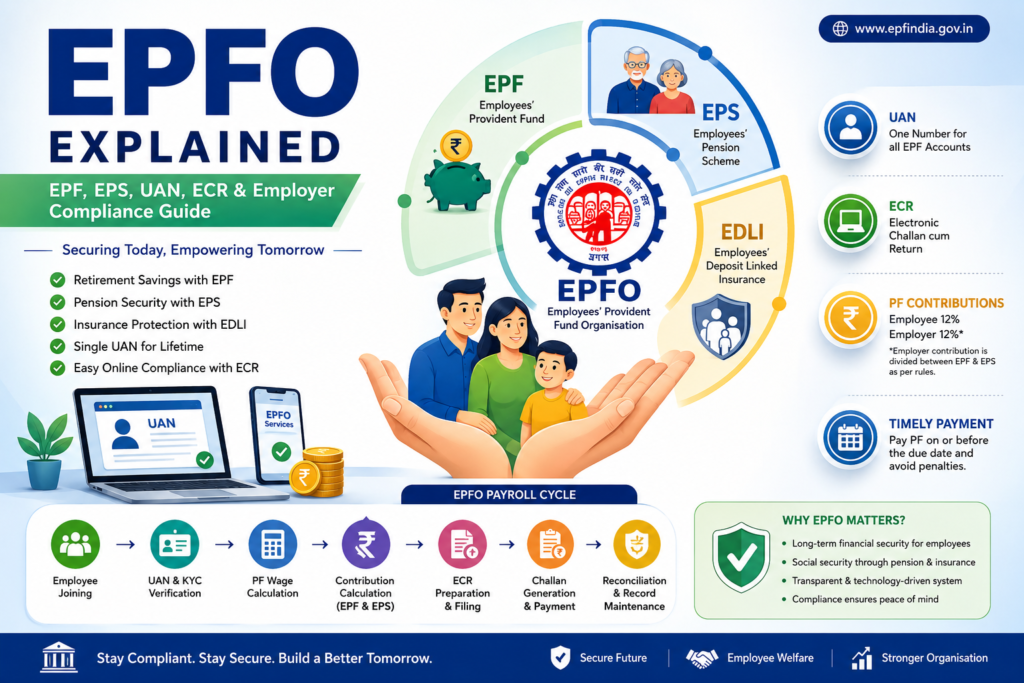
EPFO Explained: EPF, EPS, UAN, ECR and Employer Compliance Guide
The Employees’ Provident Fund Organisation (EPFO) is one of India’s major social-security organisations. It administers provident fund, pension and insurance-related benefits for eligible employees.
For HR professionals, payroll teams and employers, understanding EPFO is important because PF compliance involves employee enrolment, monthly contributions, ECR filing, challan payment, UAN management and maintaining accurate employee records.
- What is EPFO?
EPFO stands for Employees’ Provident Fund Organisation. It functions under the Ministry of Labour & Employment, Government of India.
~EPFO administers three major social-security schemes:
- Employees’ Provident Fund (EPF) Scheme, 1952
- Employees’ Pension Scheme (EPS), 1995
- Employees’ Deposit Linked Insurance (EDLI) Scheme, 1976
These schemes provide employees with retirement savings, pension-related benefits and insurance protection, subject to applicable eligibility conditions.
- What is EPF?
EPF stands for Employees’ Provident Fund.
It is a retirement savings scheme under which eligible employees and employers make monthly contributions.
~The standard contribution is generally:
- Employee contribution: 12% of applicable EPF wages
- Employer contribution: 12% of applicable EPF wages
The employee’s contribution is generally credited to EPF. The employer’s contribution is divided between EPF and EPS where applicable.
EPF helps employees build a long-term savings corpus that can be used subject to applicable withdrawal, transfer and settlement rules.
- What are EPF Wages?
EPF wages are the wages considered for determining PF contributions under the applicable EPF provisions.
EPF wages should not automatically be treated as gross salary.
For example, an employee may have:
- Basic Salary: ₹15,000
- HRA: ₹8,000
- Conveyance: ₹2,000
- Gross Salary: ₹25,000
If ₹15,000 is the applicable PF wage base, the PF calculation would be based on ₹15,000 rather than the employee’s entire gross salary.
Payroll teams should examine the applicable salary components and EPF rules before determining the contribution base.
- What is EPS?
EPS stands for Employees’ Pension Scheme, 1995.
It provides pension-related benefits to eligible EPFO members.
A portion of the employer’s statutory contribution is generally allocated towards EPS, subject to applicable eligibility and wage-ceiling rules.
The commonly applied EPS contribution rate is 8.33%, subject to the applicable statutory ceiling and rules.
For example, where EPS wages are ₹15,000:
₹15,000 × 8.33% = approximately ₹1,250
The exact contribution should be determined according to applicable EPFO rules and rounding provisions.
- EPF vs EPS
Although both are part of the EPFO framework, they serve different purposes.
Particular | EPF | EPS |
Purpose | Provident fund savings | Pension benefits |
Main contribution source | Employee + employer | Employer’s contribution |
Common rate | Employee 12%; employer portion as applicable | 8.33%, subject to rules |
Benefit | PF accumulation | Pension-related benefit |
Managed under | EPF Scheme | EPS |
Therefore, EPF and EPS should not be treated as the same contribution, even though both are connected with an employee’s EPFO membership.
- What is UAN?
UAN means Universal Account Number.
It is a unique number associated with an EPFO member and helps link the member’s different PF Member IDs.
For example, if an employee changes jobs:
UAN → Company A Member ID → Company B Member ID → Company C Member ID
The UAN provides continuity to the employee’s EPFO membership across employment changes.
Employees can use EPFO services to access relevant PF information, check contributions and manage applicable PF-related services.
- What is a PF Member ID?
A Member ID is associated with an employee’s PF membership under a particular establishment.
An employee may have different Member IDs for different employers while continuing with the same UAN.
This is why HR teams should obtain and verify an employee’s existing UAN during onboarding rather than unnecessarily creating duplicate records.
- What is ECR?
ECR stands for Electronic Challan-cum-Return.
Employers use the EPFO system to submit monthly contribution details.
~The ECR contains employee-level information relevant to PF compliance, including information such as:
- UAN
- EPF wages
- EPS wages
- EDLI wages
- Employee contribution
- Employer contribution
- EPS contribution
- Joining/exit information, where applicable
After the return is processed, the employer can generate the applicable challan and make the required payment.
- What is a PF Challan?
A PF challan is used for depositing the PF-related dues with EPFO.
The payroll process generally follows this sequence:
Payroll Calculation → ECR Preparation → ECR Filing → Challan Generation → Payment → Reconciliation
Employers should ensure that the employee-level contribution figures reported in the ECR are accurate and correspond with the amount being deposited.
- What is EDLI?
EDLI stands for Employees’ Deposit Linked Insurance Scheme.
It provides insurance-related benefits to eligible EPFO members in qualifying circumstances.
The scheme provides financial protection to the nominee/legal heirs of an eligible employee in the event of death while in service, subject to the applicable provisions.
The EDLI contribution is generally an employer-funded contribution rather than a deduction from the employee’s salary.
- EPFO Contribution Example
Consider an employee with applicable EPF wages of ₹15,000.
~Employee contribution
12% of ₹15,000:
₹15,000 × 12% = ₹1,800
~Employer contribution
12% of ₹15,000:
₹15,000 × 12% = ₹1,800
Where EPS applies and the applicable EPS wage is ₹15,000:
EPS = approximately ₹1,250
The remaining employer contribution is generally allocated towards EPF.
Therefore, the broad calculation is:
Contribution | Amount |
Employee EPF | ₹1,800 |
Employer EPS | Approx. ₹1,250 |
Employer EPF | Approx. ₹550 |
Total Employer Contribution | ₹1,800 |
The actual calculation can vary depending on the employee’s membership status, applicable wage ceiling, higher-wage contribution arrangements and other EPFO rules.
- EPF Contribution When Basic Salary is ₹25,000
A common payroll mistake is to assume that every employee with a ₹25,000 basic salary must automatically have PF calculated as:
₹25,000 × 12% = ₹3,000
This cannot be determined from Basic Salary alone.
The employer must consider factors such as:
- EPF coverage
- Applicable statutory wage ceiling
- Employee’s membership status
- Whether contribution is being made on higher wages
- EPS eligibility
- Applicable EPFO provisions
Therefore, payroll teams should first determine the applicable PF wage base and then calculate the contribution.
- EPFO Compliance Responsibilities of Employers
Employers covered under EPF provisions should maintain proper compliance processes.
~Important activities include:
- Determining employee EPF applicability.
- Collecting and verifying UAN and employee details.
- Calculating PF wages correctly.
- Calculating employee and employer contributions.
- Preparing and filing the monthly ECR.
- Generating the PF challan.
- Depositing contributions within the applicable due date.
- Maintaining employee and payroll records.
- Updating joining and exit information.
- Reconciling payroll records with EPFO records.
- What Happens When an Employee Joins?
During employee onboarding, HR/payroll should check whether the employee already has an EPFO membership/UAN.
~The employer may need to collect relevant information such as:
- UAN
- Previous PF membership details
- Aadhaar/KYC information
- Date of joining
- Salary and applicable PF wages
- Previous employment information where required
Correct onboarding information helps prevent duplicate or incorrect PF records.
- What Happens When an Employee Leaves?
When an employee leaves the organisation, the employer needs to update the relevant employment information, including the employee’s date of exit, as applicable.
The employee can then use applicable EPFO services for PF transfer, withdrawal or other eligible benefits.
Employees should generally consider transferring their accumulated PF rather than treating every job change as a reason to withdraw the PF balance.
- EPFO vs EPF: What is the Difference?
~The terms EPFO and EPF are often confused.
EPFO is the organisation.
EPF is the provident fund scheme.
-In simple terms:
EPFO = Organisation
EPF = Provident Fund Scheme
-Similarly:
EPS = Pension Scheme
EDLI = Insurance Scheme
UAN = Member’s universal account number
ECR = Electronic monthly return
- Why EPFO Compliance is Important
-Proper EPFO compliance is important for both employers and employees.
~For employees, it helps ensure:
- Correct PF accumulation
- Continuity of PF membership
- Access to eligible pension benefits
- Insurance protection under EDLI
- Easier PF transfer between jobs
~For employers, accurate compliance helps avoid:
- Incorrect PF deductions
- ECR errors
- Challan discrepancies
- Interest and damages arising from delayed payment, where applicable
- Employee complaints and compliance issues
- EPFO Payroll Cycle
~A simple EPFO payroll cycle can be understood as:
Employee Joining
↓
UAN / PF Membership Verification
↓
Salary & PF Wage Calculation
↓
Employee + Employer Contribution Calculation
↓
ECR Preparation
↓
ECR Filing
↓
Challan Generation
↓
PF Payment
↓
Reconciliation & Record Maintenance
Following this process every month helps HR and payroll teams maintain proper EPFO compliance.
Need help with ITR filing or PF withdrawal?
Talk to an Expert →