
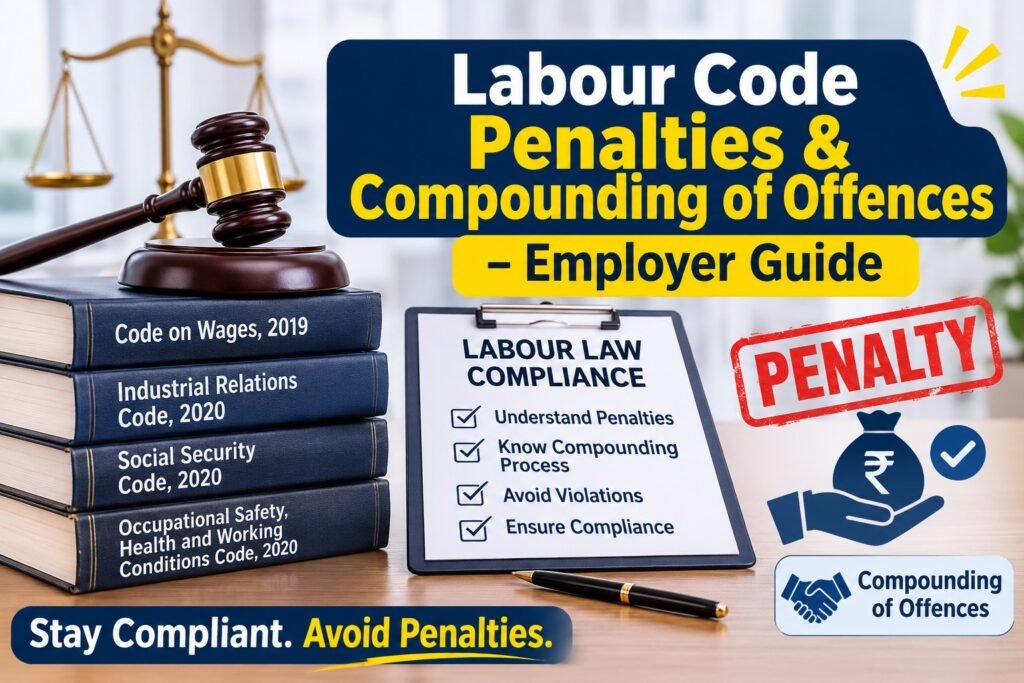
Labour Code Penalties & Compounding of Offences: Employer Guide – 2026
Introduction
India’s labour law framework has undergone significant changes with the introduction of the four Labour Codes. These Codes aim to simplify employer compliance, strengthen employee protection, reduce procedural complexity, and introduce a more structured approach to penalties and offences.
For employers, understanding labour code penalties is important because non-compliance with wage payments, employee benefits, workplace safety, statutory records, and industrial relations requirements can result in financial penalties and legal proceedings.
The new framework also provides provisions for compounding certain offences, allowing eligible violations to be settled by paying a prescribed amount instead of continuing with prosecution.
This guide explains labour code penalties, compounding of offences, repeat violations, and practical compliance steps employers should follow in 2026.
- What Are the Four Labour Codes?
The four Labour Codes consolidate and reorganise several existing central labour laws.
Labour Code | Main Compliance Area |
Code on Wages, 2019 | Minimum wages, wage payment, bonus, and equal remuneration |
Industrial Relations Code, 2020 | Trade unions, industrial disputes, strikes, and employment-related industrial relations |
Code on Social Security, 2020 | EPF, ESIC, gratuity, maternity benefits, and social security |
Occupational Safety, Health and Working Conditions Code, 2020 | Workplace safety, working conditions, health, and employment-related establishments |
Employers should identify which Code applies to their establishment and review the relevant rules, notifications, and compliance requirements.
- What Are Labour Code Penalties?
Labour code penalties are financial or legal consequences imposed when an employer or another responsible person violates applicable labour law provisions.
Depending on the nature of the offence, consequences may include:
- Monetary penalties for statutory non-compliance.
- Higher penalties for repeated violations.
- Additional penalties for continuing violations.
- Prosecution for offences involving imprisonment.
- Orders requiring the employer to correct the violation.
- Liability for failure to comply with statutory notices or directions.
The penalty depends on the specific provision, the nature of the violation, whether it is a first or repeat offence, and the applicable enforcement procedure.
Important: Labour code penalties are not uniform. Employers should not assume that every violation attracts the same fine or that every offence can be compounded.
- Penalties Under the Code on Wages, 2019
The Code on Wages covers important employer obligations relating to minimum wages, timely payment of wages, bonus, and equal remuneration.
Employers should ensure that:
- Employees receive applicable minimum wages.
- Wages are paid within the prescribed timelines.
- Wage deductions are legally permitted.
- Employees performing the same or similar work receive equal remuneration without prohibited discrimination.
- Applicable bonus obligations are fulfilled.
- Wage records and supporting documents are maintained.
Examples of wage-related non-compliance
Compliance issue | Employer risk |
Payment below applicable minimum wages | Monetary penalty and corrective payment obligations |
Delay in wage payment | Penalty or other proceedings under applicable provisions |
Unlawful wage deductions | Recovery and legal consequences |
Non-compliance with bonus provisions | Penalty and employee-related claims |
Repeated wage violations | Increased legal and financial exposure |
Under Section 56 of the Code on Wages, 2019, eligible offences may be compounded for 50% of the maximum fine prescribed for the offence.
However, this provision does not cover offences punishable with imprisonment only or offences punishable with imprisonment and fine.
A similar offence committed again within five years of an earlier compounding or conviction is excluded from the compounding provision.
- Penalties Under the Industrial Relations Code, 2020
The Industrial Relations Code regulates industrial relations, trade unions, industrial disputes, and certain employment-related obligations.
Employers should pay particular attention to:
- Compliance with applicable standing orders.
- Industrial dispute resolution procedures.
- Legal requirements relating to strikes and lockouts.
- Retrenchment and closure-related obligations.
- Prohibition of unfair labour practices.
- Compliance with settlements and awards.
Important penalty provisions
Section 86 provides penalties for specified violations.
For example:
- Certain contraventions of Sections 78, 79, and 80 attract fines ranging from ₹1 lakh to ₹10 lakh.
- A subsequent offence after conviction under those provisions may attract a fine ranging from ₹5 lakh to ₹20 lakh, imprisonment up to six months, or both.
- Certain other specified violations attract fines ranging from ₹50,000 to ₹2 lakh.
- Repeated specified violations may attract higher fines and, in applicable cases, imprisonment.
These are examples of statutory penalties, not a complete list of offences under the Code.
Employers should review the specific section applicable to their establishment before determining the potential penalty.
- Penalties Under the Occupational Safety, Health and Working Conditions Code, 2020
The Occupational Safety, Health and Working Conditions Code focuses on workplace health, safety, working conditions, and related employer responsibilities.
Employers should ensure compliance with applicable requirements relating to:
- Workplace safety measures.
- Health and welfare facilities.
- Working hours and overtime.
- Appointment letters and employee records, where applicable.
- Registration and licensing requirements.
- Safety training and protective equipment.
- Accident reporting and investigation.
- Duties of employers and persons responsible for workplace safety.
What happens when an employer violates safety requirements?
Depending on the applicable provision, a violation may result in:
- A monetary penalty.
- A compliance direction.
- Additional action for continuing non-compliance.
- Prosecution for specified offences.
- Higher consequences where the violation results in serious injury, death, or other circumstances covered by the law.
The OSH Code also provides for compounding certain specified penalties and offences.
Under Section 114, eligible penalties may be compounded for 50% of the maximum penalty, while eligible offences may be compounded for 75% of the maximum fine.
The provision excludes specified repeat violations committed within three years of an earlier compounding or conviction.
- Penalties Under the Code on Social Security, 2020
The Code on Social Security covers important employee social security obligations, including EPF, ESIC, gratuity, maternity benefits, and other applicable benefits.
For employers, compliance may include:
- Timely EPF contributions.
- Timely ESIC contributions.
- Correct employee registration.
- Accurate wage and contribution information.
- Proper maintenance of employee records.
- Compliance with applicable gratuity requirements.
- Maternity benefit compliance.
- Submission of statutory returns and information.
Common social security compliance mistakes
Mistake | Employer compliance action |
Employee omitted from statutory records | Verify employee eligibility and update records |
Incorrect wage details | Reconcile payroll with statutory contribution records |
Delayed EPF or ESIC payment | Review dues and complete applicable payment |
Incorrect employee joining or exit details | Correct records through the applicable portal process |
Missing statutory documents | Maintain supporting records and compliance evidence |
The applicable penalty depends on the relevant provision, the nature of the default, and whether the violation is repeated.
Employers should also distinguish between a statutory penalty, interest, damages, contribution arrears, and employee benefit liability. These may have separate legal consequences.
- What Is Compounding of Offences?
Compounding of offences is a legal process through which an eligible offence can be settled by paying a prescribed amount to the authorised government officer.
The objective is to resolve certain violations through monetary payment rather than continuing prosecution.
Compounding may help employers:
- Resolve eligible offences more quickly.
- Reduce the need for prolonged legal proceedings.
- Address compliance failures.
- Avoid prosecution for an offence that has been validly compounded.
- Improve their statutory compliance position.
However, compounding is not automatic.
The employer must verify that the offence is eligible, submit the prescribed application, obtain the appropriate order, and pay the amount within the permitted timeline.
- Compounding Amount Under the Labour Codes
The amount payable for compounding depends on the applicable Labour Code.
Labour Code | Compounding provision | General amount for eligible cases |
Code on Wages, 2019 | Section 56 | 50% of the maximum fine |
Industrial Relations Code, 2020 | Section 89 | 50% for eligible fine-only offences; 75% for eligible offences punishable with imprisonment up to one year or fine |
OSH & Working Conditions Code, 2020 | Section 114 | 50% of the maximum penalty or 75% of the maximum fine, depending on the case |
These percentages apply only to the offences covered by the respective provisions.
The Code on Social Security also contains provisions relating to compounding. Employers must verify the applicable section and rules rather than applying the percentages from another Code.
Example:
If an eligible fine-only offence under the Code on Wages carries a maximum fine of ₹1,00,000:
- Maximum prescribed fine: ₹1,00,000
- Compounding amount: 50%
- Amount payable for compounding: ₹50,000
This is an illustrative calculation. The actual amount depends on the offence and the applicable statutory procedure.
- Can Every Labour Law Offence Be Compounded?
No.
Certain offences may be compounded, while others are excluded.
Employers should understand the following:
Offences punishable with imprisonment only
These are generally outside the compounding provisions discussed above.
Offences punishable with imprisonment and fine
Eligibility depends on the specific Code and its compounding section.
Offences punishable with fine only
These may be eligible for compounding, subject to the applicable conditions.
Repeat offences
Repeated violations may not qualify for compounding.
For example, the Code on Wages contains a five-year repeat-offence restriction, while the Industrial Relations Code and OSH Code contain three-year restrictions for the specified offences.
Employers should check the exact statutory conditions before submitting an application.
- First-Time Offence vs Repeat Offence
The Labour Codes distinguish between certain first-time offences and repeat violations.
Particulars | First-time offence | Repeat offence |
Legal treatment | May qualify for compounding if eligible | May be excluded from compounding |
Financial consequences | Prescribed penalty or composition amount | Higher penalty may apply |
Compliance approach | Correct violation and follow applicable process | Correct violation and review repeat-offence consequences |
Legal proceedings | May be avoided through valid compounding | Prosecution or other proceedings may continue |
A repeat offence should not be treated as a routine compliance mistake.
Employers should maintain records of previous notices, penalties, convictions, and compounding orders to identify whether a new violation falls within the applicable repeat-offence period.
- Labour Code Improvement Notice and Employer Compliance
Certain provisions of the Labour Codes provide a compliance-oriented approach through notices and opportunities to correct specified violations.
An improvement or compliance notice may require an employer to take corrective action within the prescribed period.
Employers should:
- Read the notice carefully.
- Identify the relevant statutory provision.
- Understand the violation mentioned.
- Review the compliance deadline.
- Correct the issue.
- Submit supporting documents or evidence.
- Preserve the notice and compliance records.
The notice process is not a blanket exemption from penalties.
Serious offences, specified violations, repeat offences, and cases covered by separate statutory provisions may be treated differently.
- Employer Procedure for Compounding an Offence
Employers should follow a structured process when they receive a notice relating to a labour law offence.
Step 1: Identify the violation
Determine the exact nature of the offence.
Check whether it relates to wages, social security, industrial relations, workplace safety, or another statutory obligation.
Step 2: Identify the applicable Labour Code
Confirm which Code and section apply.
Do not calculate a compounding amount based only on the general penalty framework.
Step 3: Check whether the offence is compoundable
Review the applicable compounding provision.
Confirm whether the offence is eligible and whether any repeat-offence restriction applies.
Step 4: Correct the underlying compliance issue
Complete the required corrective action.
For example:
- Pay outstanding wages.
- Correct employee records.
- Reconcile statutory contributions.
- Update required registers.
- Address workplace safety deficiencies.
Step 5: Submit the prescribed application
Submit the compounding application to the authorised officer in the prescribed form and manner.
The Code on Wages Central Rules, 2026 provide for an application in Form VI under Rule 54.
The procedure under other Codes must be checked separately.
Step 6: Pay the prescribed amount
Pay the composition amount within the period specified in the order.
For the Code on Wages procedure, the applicable Central Rules provide for payment within 30 days of the composition order.
Step 7: Obtain the composition certificate
Keep the composition order, payment proof, and certificate safely.
These documents help establish that the specific offence was validly compounded.
Step 8: Maintain compliance records
Update the internal compliance tracker and preserve the supporting documentation.
- Documents Employers Should Maintain
Employers should maintain the following records, as applicable:
- Labour department notice or inspection report.
- Registration and licence documents.
- Employee master data.
- Attendance and wage registers.
- Payroll records.
- EPF and ESIC contribution records.
- Payment challans.
- Statutory returns.
- Workplace safety records.
- Corrective action reports.
- Compounding application.
- Compounding order.
- Payment receipt.
- Composition certificate.
Proper documentation helps employers demonstrate corrective action and support their position during inspections or legal proceedings.
- Common Employer Mistakes
Employers should avoid the following mistakes:
- Ignoring labour department notices
Failure to respond within the prescribed period can increase legal exposure.
- Assuming every offence is compoundable
The compounding provisions contain specific eligibility conditions and exclusions.
- Paying without checking the statutory provision
The amount should be calculated under the correct Code and section.
- Treating compounding as a substitute for compliance
Payment does not automatically remove the underlying wage, contribution, or employee benefit obligation.
- Repeating the same violation
Repeat offences may attract higher penalties and may not qualify for compounding.
- Failing to maintain records
Without supporting documents, employers may find it difficult to establish compliance.
- Ignoring state-specific requirements
Employers must review the applicable Central and State rules, notifications, and enforcement procedures.
- Labour Code Compliance Checklist for Employers – 2026
Employers can use the following checklist to review their compliance position.
- Verify applicable Labour Code registration and licensing requirements.
- Review minimum wage and wage payment compliance.
- Reconcile payroll with statutory contribution records.
- Check EPF and ESIC employee registration and contribution details.
- Review gratuity and maternity benefit compliance.
- Verify working hours and overtime records.
- Review workplace health and safety requirements.
- Maintain required employee records and registers.
- Check pending labour department notices.
- Identify previous penalties and compounding orders.
- Verify whether any repeat-offence restrictions apply.
- Correct identified compliance gaps.
- Maintain supporting documents and payment evidence.
- How Employers Can Reduce Labour Code Penalty Risks
A preventive compliance system is more effective than responding only after receiving a notice.
Employers should consider:
Regular compliance reviews
Conduct monthly or quarterly reviews of wage payments, statutory contributions, employee records, and workplace compliance.
Payroll reconciliation
Compare payroll data with EPF, ESIC, and other applicable statutory records.
Employee record verification
Check joining dates, exit dates, wage details, employee identifiers, and statutory eligibility.
Compliance calendar
Maintain a calendar for statutory payments, returns, registrations, renewals, and other applicable deadlines.
Internal documentation
Preserve challans, acknowledgements, notices, registers, and corrective action records.
Professional compliance support
Seek professional assistance where the employer receives a notice, faces a repeat-offence issue, or needs to determine whether an offence can legally be compounded.
Conclusion
Labour Code penalties and compounding of offences are important aspects of employer compliance in 2026.
The four Labour Codes introduce a structured approach to statutory violations, including monetary penalties, higher consequences for certain repeat offences, and provisions for compounding eligible cases.
However, employers should remember that:
- Not every offence is compoundable.
- Compounding percentages differ between the Codes.
- Repeat-offence restrictions must be checked carefully.
- Employee dues and corrective compliance obligations may continue.
- The applicable Central and State rules must be reviewed.
The best approach for employers is to maintain accurate payroll records, complete statutory payments on time, review employee compliance regularly, and respond promptly to labour department notices.
A proactive compliance system can help businesses reduce avoidable penalties, improve workplace practices, and maintain a stronger statutory compliance position.
This article is for general informational purposes and is not legal advice. Labour Code applicability, penalty provisions, compounding eligibility, and procedures should be verified against the latest applicable Acts, rules, notifications, and State requirements before taking action.
Need help with ITR filing or PF withdrawal?
Talk to an Expert →