
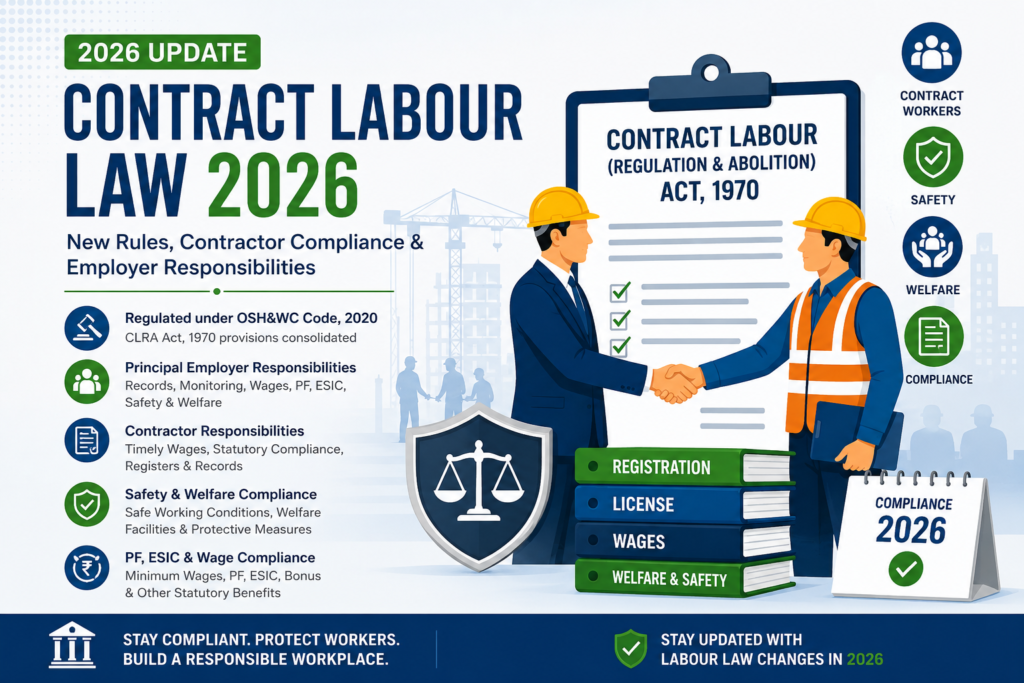
Contract Labour Law 2026 New Rules, Contractor Compliance & Employer Responsibilities:-
Contract labour compliance is an important responsibility for businesses that engage workers through contractors. In 2026, employers in Maharashtra need to pay attention to the changing framework under the Occupational Safety, Health and Working Conditions (OSH&WC) Code, 2020 and the Maharashtra rules being developed for its implementation.
1. Contract Labour Law in 2026
The Contract Labour (Regulation and Abolition) Act, 1970 (CLRA Act) has been consolidated into the OSH&WC Code, 2020. The new framework covers important areas such as contract labour engagement, licensing, welfare facilities, working conditions and responsibilities of the principal employer.
For employers, this means existing contractor arrangements should be reviewed against the new labour-code framework and applicable Maharashtra rules.
2. Maharashtra Draft Rules
Maharashtra published draft rules relating to the OSH&WC Code in May 2026. These rules are important for employers and contractors because they provide the state-level framework for implementing the Code.
Since these were issued as draft rules, businesses should distinguish between provisions that are already legally effective and proposals contained in the draft.
3. Principal Employer Responsibilities
~A principal employer engaging contract workers should maintain proper compliance systems. Key areas include:
• Verification of contractor licences and registrations
• Maintaining required records and worker details
• Monitoring timely payment of wages
• Ensuring applicable PF and ESIC compliance
• Providing required welfare and safety facilities
• Monitoring working hours, leave and statutory benefits
• Maintaining contractor agreements and compliance documents
The principal employer should not assume that appointing a contractor completely transfers its compliance responsibility.
4. Contractor Responsibilities
Contractors are responsible for complying with applicable labour requirements for their workers. This generally includes proper wage payment, maintaining employee records, statutory contributions and providing required employment-related documentation.
Contractors should also ensure that workers receive applicable benefits and that statutory returns and records are maintained correctly.
5. Safety and Welfare of Contract Workers
The OSH&WC framework places significant importance on occupational safety, health and working conditions.
Employers should therefore review whether contract workers are receiving appropriate safety measures, welfare facilities, protective equipment where required and a safe working environment.
6. PF, ESIC and Wage Compliance
Contract labour compliance is not limited to licensing. Businesses should regularly verify:
• EPF contributions
• ESIC contributions
• Minimum wages
• Wage slips and payment records
• Attendance and working-hour records
• Applicable bonus and other statutory benefits
Proper documentation is especially important during labour inspections or compliance audits.
7. What Employers Should Do in 2026
Businesses using contract labour should conduct a compliance review covering their contractors, worker records, statutory registrations, wage payments, PF/ESIC records and safety arrangements.
They should also monitor the final Maharashtra rules and government notifications because draft provisions can change before final notification.
Free Consultation
Need help with ITR filing or PF withdrawal?
Talk to an Expert →
superadmin
Tax & PF Consultant