
TITLE: Gratuity After One Year: Understanding the New Eligibility Rule
Introduction
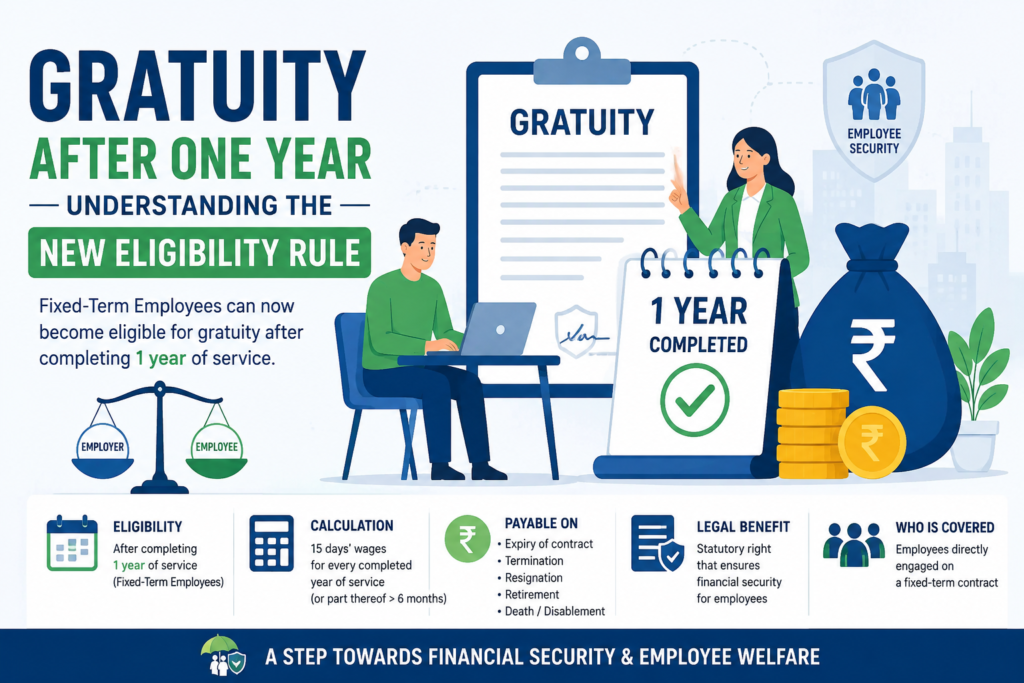
Gratuity is an important statutory benefit provided to employees at the end of their employment. With the implementation of the Labour Codes, one major change has attracted attention in 2026: Fixed-Term Employees (FTEs) can become eligible for gratuity after completing one year of service.
This does not mean that every employee who completes one year with a company will automatically receive gratuity. The one-year provision specifically applies to employees engaged under Fixed-Term Employment.
The Ministry of Labour & Employment has clarified that an FTE is eligible for gratuity when the employee renders service under the contract for one year from the start of the contract.
1. What Is the New 1-Year Gratuity Rule?
Under the new Labour Code framework, Fixed-Term Employees receive a special gratuity benefit.
An FTE who completes one year of service under the fixed-term contract can become eligible for gratuity. The benefit is available without requiring the traditional five years of continuous service applicable in the normal case.
For example:
• Employee joins under a fixed-term contract: 1 April 2026
• Contract completes one year: 31 March 2027
• The employee can become eligible for gratuity under the FTE provision.
The Ministry has specifically clarified that the one-year period is counted from the start of the contract.
2. Does the 1-Year Rule Apply to All Employees?
No.
This is one of the most important points for employers and payroll teams.
The one-year gratuity provision is for Fixed-Term Employees. It should not be interpreted as a general rule that every permanent employee becomes eligible for gratuity after completing one year.
For regular employees, the general five-year continuous-service requirement continues to be relevant, subject to statutory exceptions such as death or disablement.
Therefore, HR teams should first identify whether an employee is actually engaged under a valid Fixed-Term Employment contract.
3. Who Is a Fixed-Term Employee?
Fixed-Term Employment generally refers to an employee who is directly engaged by the employer for a fixed period under a written employment contract.
The Ministry has clarified that Fixed-Term Employment covers employees directly engaged by the employer. It does not automatically include contract labour supplied through a contractor.
This distinction is important for companies that have both:
• Direct fixed-term employees
• Contract workers supplied through manpower contractors
The gratuity treatment can be different for these categories.
4. How Is Gratuity Calculated for an FTE?
The gratuity benefit for Fixed-Term Employees is calculated on a pro-rata basis.
The general formula is based on:
Gratuity = Last Drawn Wages × 15/26 × Completed Years of Service
For FTEs, the benefit can be calculated proportionately according to the period of service as prescribed under the applicable provisions.
The Ministry’s FAQs state that gratuity is calculated at 15 days’ wages for every completed year of service or part thereof in excess of six months, with special treatment for fixed-term employment.
Example
Suppose:
• Last drawn monthly wages = ₹30,000
• Fixed-term service = 1 year
Approximate gratuity:
₹30,000 × 15 ÷ 26 = ₹17,308
Therefore, the employee’s gratuity for one completed year would be approximately ₹17,308, subject to the applicable wage definition and statutory calculation.
5. New Definition of Wages and Gratuity
Another important Labour Code change concerns the definition of wages.
For gratuity calculations, the revised wage definition applies from 21 November 2025, the date on which the Labour Codes were implemented. The Ministry has clarified that the change in gratuity calculation is applicable prospectively from this date.
Where specified allowances exceed the permitted 50% threshold under the wage definition, the excess can be added back for statutory wage calculations.
This can increase the gratuity calculation base for certain salary structures.
6. When Is Gratuity Payable?
Gratuity can become payable on events such as:
• Termination of employment
• Retirement/superannuation
• Resignation
• Death or disablement
• Expiration of a fixed-term employment contract
• Other events specified under the applicable law
The Labour Ministry’s FAQ specifically includes expiration of a fixed-term employment contract as an event for gratuity payment.
7. What Employers Should Do in 2026
HR and payroll teams should review their employee records and salary structures to ensure correct gratuity treatment.
Employers should:
1. Identify all Fixed-Term Employees.
2. Check the start and end dates of each contract.
3. Track completion of one year of service.
4. Review the wage components used for gratuity.
5. Calculate gratuity correctly at the time it becomes payable.
6. Maintain proper employment contracts and payroll records.
7. Ensure regular employees are not incorrectly treated as FTEs merely to apply the one-year rule.
Need help with ITR filing or PF withdrawal?
Talk to an Expert →